
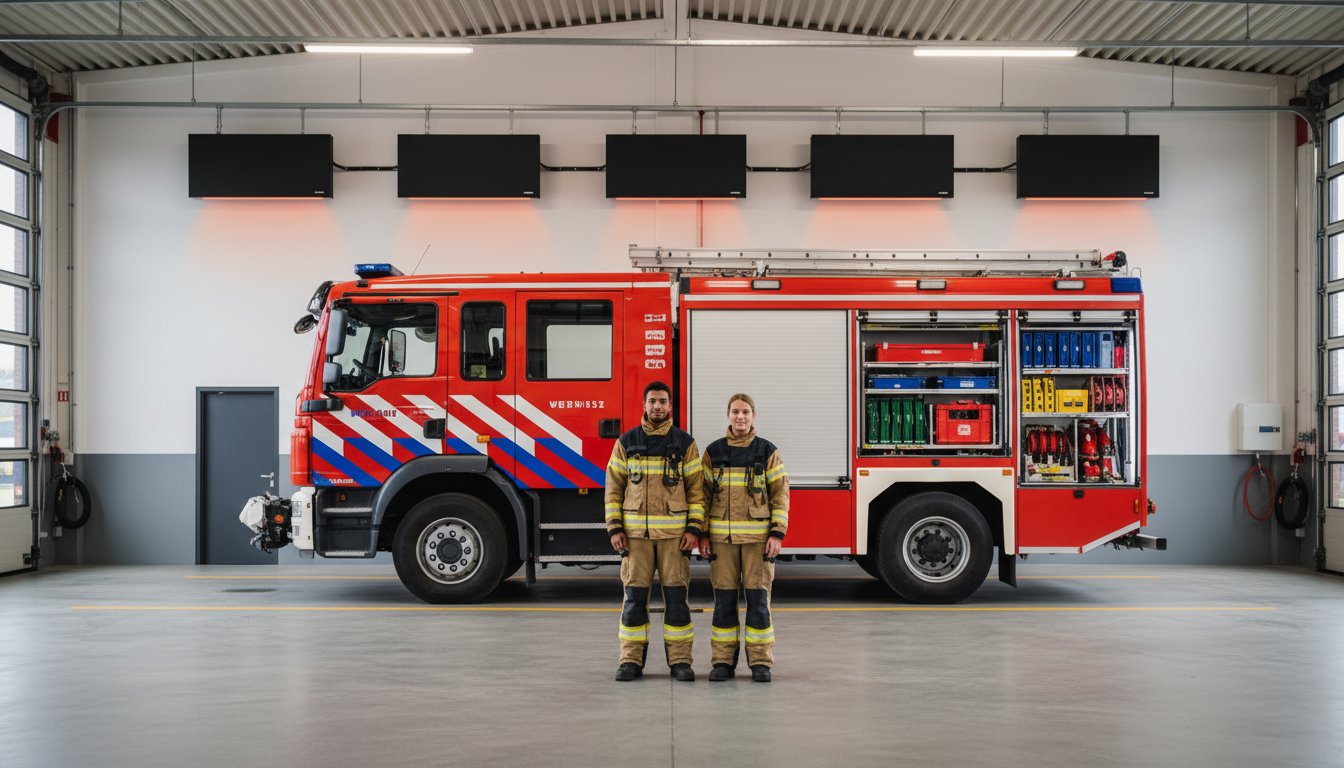
A fire station’s vehicle bay, workshop, office and changing room have different heating needs. Doors open, vehicles move and occupancy varies. Targeted electric heat may suit certain positions, but requires design that respects operational readiness and safety procedures.
Key considerations
Map functions and occupied positions by zone. Check coverage, obstacles, moisture and electrical capacity. Keep heating separate from prescribed cleaning, decontamination and drying of protective equipment. An infrared label does not make an appliance automatically fire-safe or exempt from inspection.
Analysing doors, occupancy and heat loss
Open vehicle doors remove warm air and increase losses. Radiant heat may continue to reach a workstation, but cannot guarantee stable comfort during every departure. Wind and incoming air cool surfaces too. Compare local heating with the existing system for equivalent tasks and schedules.
Choosing appliance and mounting for a high bay
A warm panel emits radiation and convection, with distribution depending on model and mounting. High bays require attention to mounting height, work positions and vehicles; fixed beam angles or general height ranges are not guarantees. A domestic ceiling panel is not automatically an industrial heater.
Assess structural support, fixings and clearance for lifting equipment, doors and maintenance. Preserve required distances from vehicles, storage and equipment even when moved. Consider electromagnetic compatibility and communications equipment where relevant; do not assume absolute freedom from interference.
Safety as part of the design
Electric heating has no local gas combustion but still has hot surfaces and electrical risks. Thermal protection does not make covering or incorrect placement safe. Assess combustible materials, storage, vehicle impact and nearby work. Check product documents and have the responsible installer assess the installation.
Wash bays need separate assessment of jets, cleaning agents, moisture and connections. IP44 is not general permission for pressure washing. Certificates apply to defined products and tests, not a guarantee that every station risk is eliminated.
Treating different functions separately
Local warmth may suit a workbench; offices or changing rooms may need whole-room heating. Establish demand, occupancy and controls for each zone. Reduce temperatures elsewhere only when building, materials and operations permit. Motion sensors may miss staff working still.
Do not treat a room panel as a validated drying or decontamination system for protective clothing. Follow the equipment’s procedures and instructions, including temperatures and cleaning. Heat does not remove soot or contamination. Drying and ventilation require separate process design.
Agreeing installation, controls and management
Calculate heat loss, required load and available electrical capacity. Coordinate switching and any priority control with charging, lighting and other major loads. Plan work around response routes and operational functions. Agree controls and power or communications failure behaviour beforehand.
Low maintenance does not mean exemption from inspection or service. Define cleaning, visual checks, access at height and responsibilities. Compare investment, electricity and management with alternatives without fixed lifespan or savings promises. Have tax options checked for the project and current conditions.
From assessment to quotation
We support business end users, installers and wholesalers with product choice, and private end users with other applications. For a fire station share plans, heights, zones and installation data. Request a quotation clearly identifying equipment, controls, mounting and any additional assessment.
Frequently asked questions
Will solar panels supply all the heating?
That depends on simultaneous generation, heat demand and other loads. Annual yield does not prove sufficient power on a winter morning. Calculate grid use and cost for actual schedules; solar does not automatically make the project emission-free or grid-independent.