
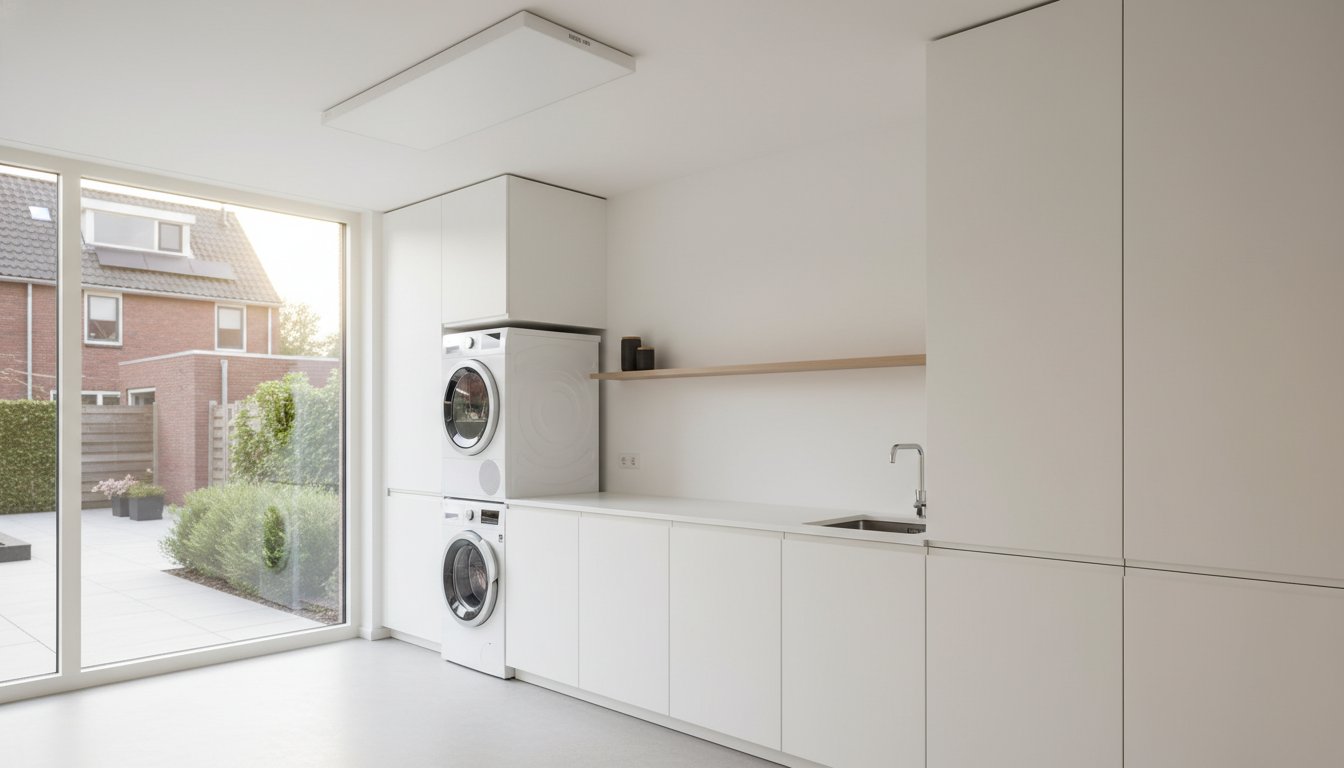
Utility rooms often combine laundry, appliances, storage and an outside door. Heating must fit both the work area and available clear space. An infrared panel may be considered for supplementary or room heating, but is not a solution to every moisture problem. Here we examine layout through daily use.
Key considerations
Decide between warmth for a task and maintaining the whole room. Draw appliances, drying racks, cupboards and the opening door. Check moisture sources and electrical load. Laundry must not encroach on the heater’s required clear space.
Assessing warmth where you work
A panel radiates towards exposed people and surfaces and also produces convection. Tall cupboards, worktops and hanging laundry may limit warmth reaching the user. Assess the actual working position. Opening doors still cause heat loss; infrared does not undo draughts or poor insulation.
The appliance and cold room need warm-up time. Short visits therefore do not automatically suit switching on only at entry. Choose and test a programme matching tasks and background conditions without fixed five- or ten-minute promises.
Laundry, moisture and electricity use
Drying laundry releases moisture into the room. Heating does not remove it. Check ventilation, appliance exhaust and leaks before choosing more heating as the solution. A panel does not guarantee mould-free walls, fresh air or faster drying. Never place textiles on or against it to speed drying.
Calculate costs using actual kilowatts, running hours and your tariff. Include controls, installation and maintenance. With a thermostat, not every scheduled hour is a full consumption hour. A fixed monthly figure or guaranteed advantage over an electric radiator requires an equivalent comparison.
Comparing panels and other heaters
Resistance heaters ultimately convert nearly all consumed electricity into heat. Radiation, convection, layout and controls differ. Compare the same comfort requirement rather than material or brand alone. Adjusting an existing radiator may also be an option; replacement is not always necessary.
Programmable controls may reduce unnecessary hours when matched to use. Motion detection may miss a stationary worker and does not control moisture. Check compatibility and test local operation and failure behaviour. An app reports consumption only if the combination has suitable metering.
Creating a layout and output plan
For the whole room, determine heat loss from insulation, exposed surfaces, glazing, ventilation, height and required temperature. A standard 60–100 watts per square metre or 600 watts for six square metres does not suit every case. Extra capacity does not guarantee lower use. For local heat also assess distance and exposure.
Ceiling mounting may free wall space, but requires an approved model, structure and fixings. It does not automatically create underfloor heating. Have the installer assess simultaneous load with washing machines, dryers and other appliances. An existing socket does not prove adequate electrical capacity.
Assess moisture exposure and approved positioning together with the electrical installation. An IP code alone does not approve mounting near every tap or water connection. Maintain required clearances from appliances, storage and textiles. Assess hot surfaces and prevent contact by children or pets.
Our help with utility-room heating
We help private and business end users, installers and wholesalers. Send a plan, photos, insulation information and intended use. Show drying racks, appliances and existing heating. Choose finish, colour and any lighting from actual available models.
Check everyday use
Test comfort and controls during actual tasks. Recheck clearances after moving laundry or storage. Follow cleaning and inspection instructions for mounting, connections and controls. Low maintenance does not remove inspections; smells, damage or unusual operation need assessment before continued use.
Request a utility-room heating quote
Frequently asked questions
Should heating run only while I am there?
That depends on use and building conditions. A task may need different warmth from background conditions for storage or frost-sensitive components. Presence detection cannot generally guarantee those conditions. Match controls to the complete application.