
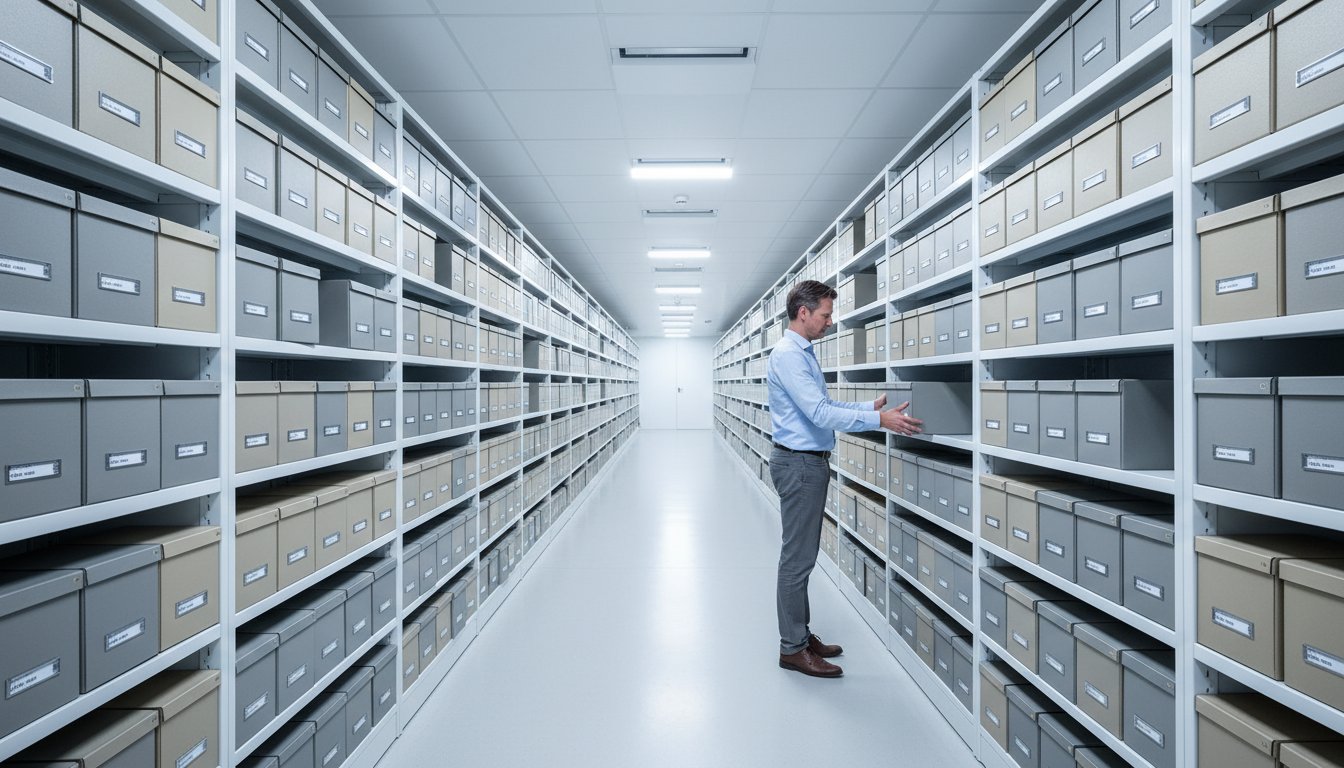
In an archive, collection preservation comes first. Choosing heating therefore involves more than a comfortable staff temperature. An infrared panel can warm people and surfaces locally; whether this suits stored paper, photographs or other materials must be assessed within the complete conservation and climate plan.
Key points
First establish climate requirements for the specific collection with its manager or conservation specialist. A heating panel is neither a standalone conservation system nor a dehumidifier. Direct radiation can cause unwanted local heating of stored material. Monitoring, fire precautions, moisture control and the complete installation remain separate requirements.
Climate requirements start with the collection
Paper, parchment, photographs and storage media may require different conditions. Determine which requirements, internal policies and legal provisions apply to your depot. Do not adopt one temperature or humidity limit for all materials without assessment. Define permitted changes, measurement locations and responses to deviations too.
Investigate leaks, cold building elements, air leakage and moisture sources before treating heating as the solution. Heating can change relative humidity but does not itself remove water. Moisture removal or dehumidification needs suitable design; a warm wall does not prove suitable conditions inside a box.
What radiant heat can and cannot reach
A panel radiates towards exposed surfaces and also produces convection. Shelves, cabinets and boxes shield material behind them. Radiation does not automatically warm the core of stacked paper or closed packaging. Stored objects are not a thermal buffer to heat deliberately without conservation assessment.
Separate comfort at a worktable from storage conditions. Temporary local staff heating may have different requirements from a stable collection climate. An occupancy sensor must not switch off essential preservation conditions because the room is empty. Separate these functions in design and control.
Compare risks across the whole installation
An electric panel without a water circuit adds no heating-water pipe at that position. It does not remove every water or fire risk: the roof, other pipes and building remain relevant. Compare climate performance, safe heat delivery, reliability and management rather than describing any technology as risk-free.
A fanless appliance has no forced fan airflow, but natural convection and air movement remain. The panel does not filter dust or remove microorganisms from collections. Cleaning, any filtration and pest or mould procedures belong in collection management.
Positioning around shelves and storage
Map fixed and mobile shelving, maximum storage height, aisles and work positions. Compare panel locations in every storage configuration. Ceiling mounting is not automatically unobstructed and must not cause unwanted direct heating of vulnerable objects. Preserve access to lighting, detection and maintenance.
Determine output from heat loss and the established climate requirements. A rule per cubic metre is not a depot design. Include ventilation, any cooling or dehumidification and resilience. Heating one aisle does not demonstrate adequate conditions throughout storage.
Set clearance from paper, cardboard and other combustibles using model instructions and the complete fire assessment. Do not treat a generic minimum as a guarantee. Prevent later stock expansion from filling clearances. Check supporting structure, brackets, connections and cable routes before commissioning.
Measure, alert and respond
Place sensors to represent collection conditions, not merely where a thermostat is convenient. Record data across storage locations and seasons. A Wi-Fi thermostat does not inherently measure humidity or provide reliable alarm records. Check sensors, calibration, coverage, data storage and response during network failure.
Coordination for an archive project
We discuss product options with private and business end users and support installers and wholesalers with supply. For archives, involve the collection manager, conservation specialist and climate designer too. Share plans, storage layout, requirements and measurements. Product advice is not certification of preservation conditions.
Compare investment, electricity, monitoring, maintenance and replacement together. Electric heating is not automatically carbon-free or nearly free with solar panels. Check incentives or tax relief against current official rules for the specific investment. Budget a benefit only once eligibility is clear.
Commission with monitoring and management arrangements
After installation, check actual conditions before accepting the solution as suitable. Assign responsibility for deviations and power or equipment failures. Reassess new shelving, collection changes or operating hours. Follow cleaning and inspection instructions for the appliance and electrical system.
Archive heating questions
Does a panel protect paper from mould and pests?
No, that is not a guaranteed product function. Have damage assessed by the responsible specialist and address causes and management measures. A higher temperature or directly heated box does not prove the problem is resolved.
Can it respond only to occupancy?
Not if that compromises preservation conditions. The collection has requirements even when no staff are present. Assess local staff heating and storage climate control separately and coordinate them.