
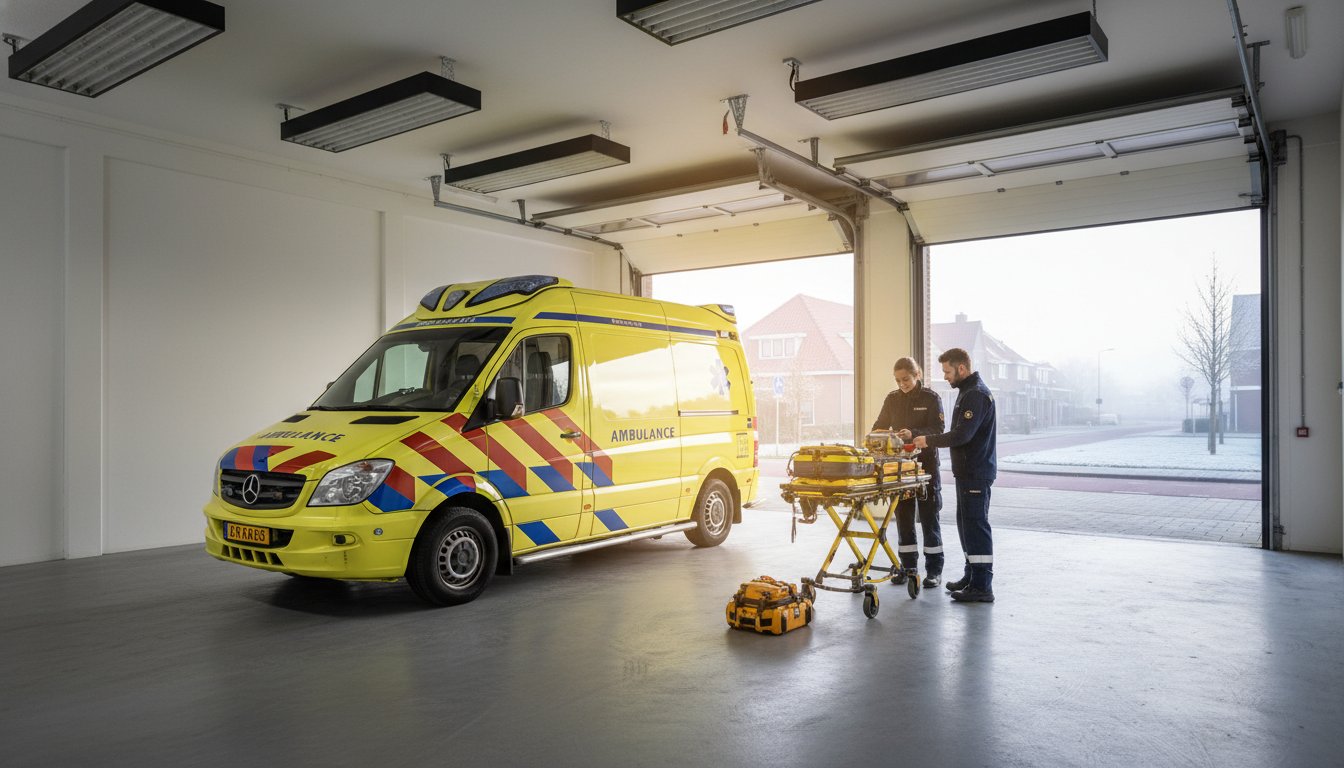
An ambulance station contains different climate zones: vehicle hall, reporting area, rest rooms and storage. Their heating needs and occupancy differ. Infrared panels may form part of the plan, but selection must fit operations, building services and requirements for vehicles and materials.
Key design questions
Separate staff comfort from vehicle readiness and storage conditions. Establish how doors, ventilation, zoning and electrical capacity affect the design. Define responsibilities, failure behaviour and checks. A general heating panel alone does not demonstrate medical suitability or compliance with all building requirements.
Assessing each use separately
For each room, record occupancy, required comfort, heat loss and existing heating. For the hall, include door dimensions, opening duration, vehicle routes and height. Check supplier-specific temperature and operating requirements for vehicles and stored items. A room-thermostat reading does not automatically represent conditions inside a vehicle or cupboard.
An open door causes heat loss with infrared heating too. Radiation can warm exposed people and surfaces, but cold air, draughts and cooling structures still matter. Do not expect instant comfort after every departure; assess recovery under actual conditions.
Where targeted heat may fit
A reporting desk or work zone may benefit from local warmth, while rest rooms need an appropriate overall environment. Assess distance, exposure, seated or lying positions and obstructions. Panels also produce convection. They do not replace ventilation, vehicle-exhaust extraction or cleaning procedures.
Controls may follow schedules and presence where occupancy permits. A motion detector may miss seated or sleeping occupants. Establish preheating requirements and prevent an automatic absence mode from compromising critical conditions. Emergency-service readiness must inform the design.
Comparing systems against the same requirements
Compare existing heating, heat pumps and resistance heating at equivalent coverage and comfort. Include investment, electrical capacity, energy, maintenance and replacement. Fixed air-temperature reductions, payback or fifteen-year savings require project analysis. Solar electricity is not automatically available through winter nights.
Low maintenance does not remove the need for checks. Follow manuals and the management plan for cleaning, mounting, connections, controls and fault response. Assess switching sounds in rest rooms too. A fluid-free panel does not automatically protect other pipes or stored materials from frost.
Positioning, vehicles and building services
In the hall, check coverage and positioning against vehicle height, open doors, access routes, maintenance and equipment. A panel above an ambulance does not guarantee ice-free glass, correct medicine temperatures or a warm vehicle interior. Those conditions require separate specifications and appropriate measurements.
Have structure, approved mounting, clearances and electrical load assessed. Check suitability near medical or communication equipment with the relevant suppliers; general CE marking does not demonstrate every combination. Avoid interference with fire detection, ventilation and other building services.
Building-management integration needs compatible controllers and interfaces. Define sensors, controls, alarms and responses to failures or door contacts for each zone. KNX, Modbus and other protocols are not standard features of every panel. Test the whole chain, including recovery and the agreed contingency procedure.
Our role in the project
We support business end users, installers and wholesalers with product selection. For ambulance stations, we coordinate the brief with facilities management and installation advisers. Send a floor plan, usage profiles and technical constraints. Choosing one product does not automatically establish compliance with building-performance or medical requirements.
Handover and practical assessment
Agree comfort criteria, measurements and acceptance beforehand. Trial the installation during normal occupancy, door openings and representative cold conditions. Hand settings, manuals and fault procedures to the manager. Revise coverage, preheating or controls if the trial shows they do not meet the brief.
Request a quote for your ambulance station
Frequently asked questions
Does a panel replace medical-storage climate control?
No. Follow the specific storage and operating requirements for materials and equipment. Match monitoring and systems to them. Human comfort and demonstrable storage conditions are different design tasks.