
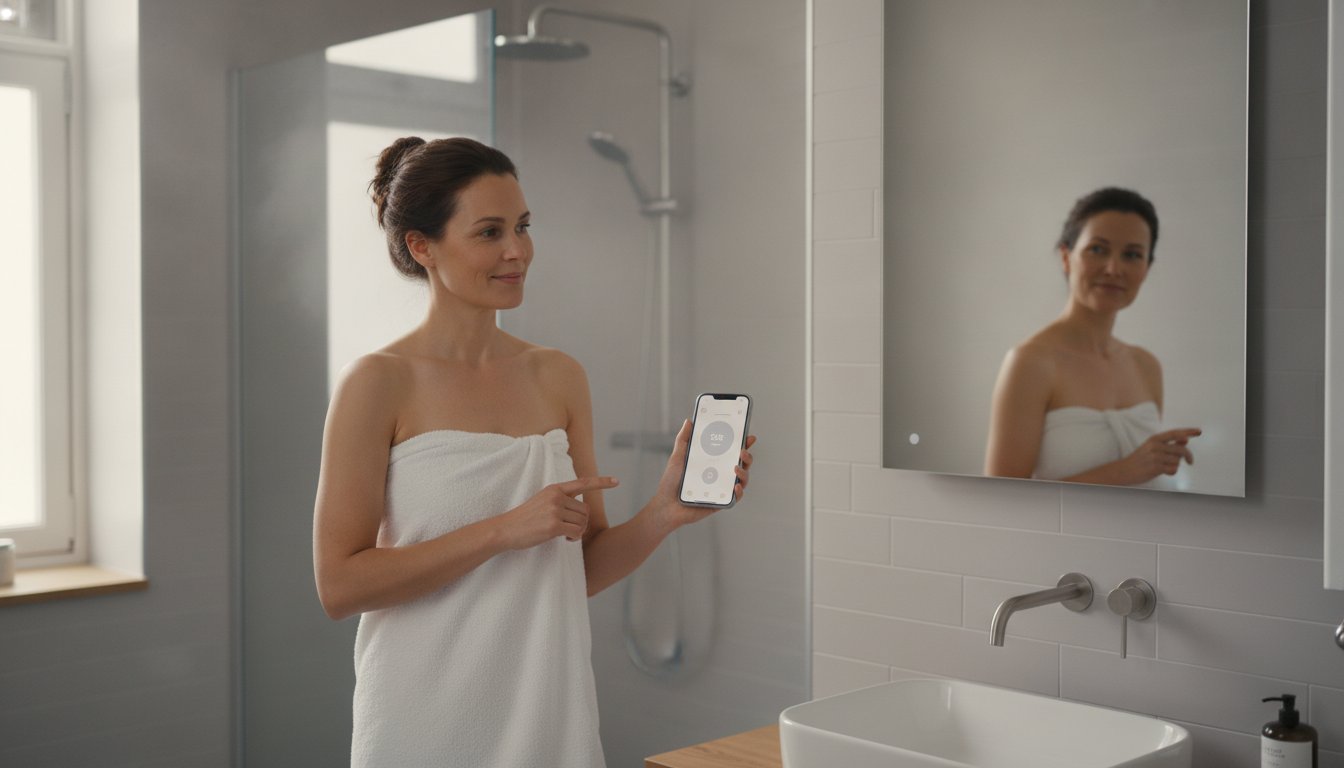
An infrared panel with a thermostat can serve a bathroom as a separate heating zone. Panel, controls and installation must suit one another. Start with heating needs and a safe position, then consider weekly schedules or apps. Not every bathroom needs the same solution.
This guide assesses the whole combination, including mirror condensation, warm-up and operation. It promises neither a fixed warm-up time nor automatic savings. Results depend on starting temperature, insulation, ventilation and the equipment chosen.
Key points
Have the exact location and electrical conditions assessed. Check the complete panel, sensor and receiver combination. Set a realistic schedule and maintain ventilation. A heater does not guarantee a dry bathroom, and an IP code alone does not determine permissible mounting.
Comfort and control in a separate zone
Programmable controls can match temperature to use. Allow for panel and room warm-up. A sensor starting only on entry may be too late for short visits. Choose settings for the actual room rather than a fixed morning or evening schedule.
Compare total costs with existing heating at the same comfort requirement. Electric resistance heat is not automatically cheaper than a boiler or heat pump. Thermostats can limit unnecessary hours, but insulation, tariffs and simultaneous use of other heating also matter.
Heat transfer, mirrors and moisture
Panels transfer heat through radiation and convection. People and surfaces absorb radiation while air also warms. Ventilation still removes heat and remains necessary. No fan does not mean no air movement, dust or moisture. The appliance provides comfort, not treatment for allergies or asthma.
A heated mirror may fog less when its surface is warm enough for room humidity. This is not a permanent anti-condensation guarantee. Check whether it provides demisting or sufficient room-heating output. Switching off can cool the mirror. Recurring damp or mould also requires checking ventilation and its cause.
Which thermostat suits your panel?
Built-in controls may belong to a purpose-designed model; external thermostats offer separate sensing. Assess instructions, sensor position and use; built-in does not automatically mean inaccurate. Wired or wireless controls must be explicitly compatible with panel and receiver.
Check switching capacity, load type, receiver limits and sensors. Wi-Fi is not required for temperature control. Choose apps where useful and verify actual functions. Voice control and metered consumption are not standard; an app may show estimates only. Ask what operates locally during faults.
Mounting and electrical assessment
Assess exact position, product approval, IP protection and electrical requirements for each part together. Avoid universal zone or distance rules from general articles. Protection and any earthing depend on appliance and installation. Have fixed wiring and alterations done by a qualified installer.
Choose wall or ceiling mounting only where permitted. Check support, fixings and clearances to people and materials. A high position over a shower is not automatically safe. Do not cover standard panels with towels; use accessories only with approval for that version.
Place sensors at representative positions according to the manual. Avoid strong local heat, sun or draughts and do not apply arbitrary large offsets. Panel surfaces may burn even on brief contact. Consider children and other users when positioning panels and cables.
Advice for your bathroom project
We advise private and business end users and work with installers and wholesalers. Share dimensions, height, photographs, insulation, ventilation and intended use. Say whether heating supplements or replaces another system. We assess needs, models and controls together. Warranty and service terms vary by version.
Assess operation during normal use
Test heat demand, shutdown and schedules after installation. Observe timely comfort and adjust start time or temperature separately. Low maintenance still requires checks: follow cleaning, battery and damage instructions. Safely switch off and cool before cleaning.
Frequently asked questions
How many watts for six square metres?
Floor area alone cannot determine this. Heat loss, height, glazing, ventilation, starting temperature and intended use matter. Do not adopt a fixed 360-to-600-watt answer without those details. Suitable capacity must also fit a safe mounting location.
How early should heating start?
Test with your panel and bathroom. Time to felt warmth differs from warming all surfaces and air. A general ten-to-fifteen-minute rule is not a guarantee. Use supported adaptive start as instructed and recheck in colder weather.