
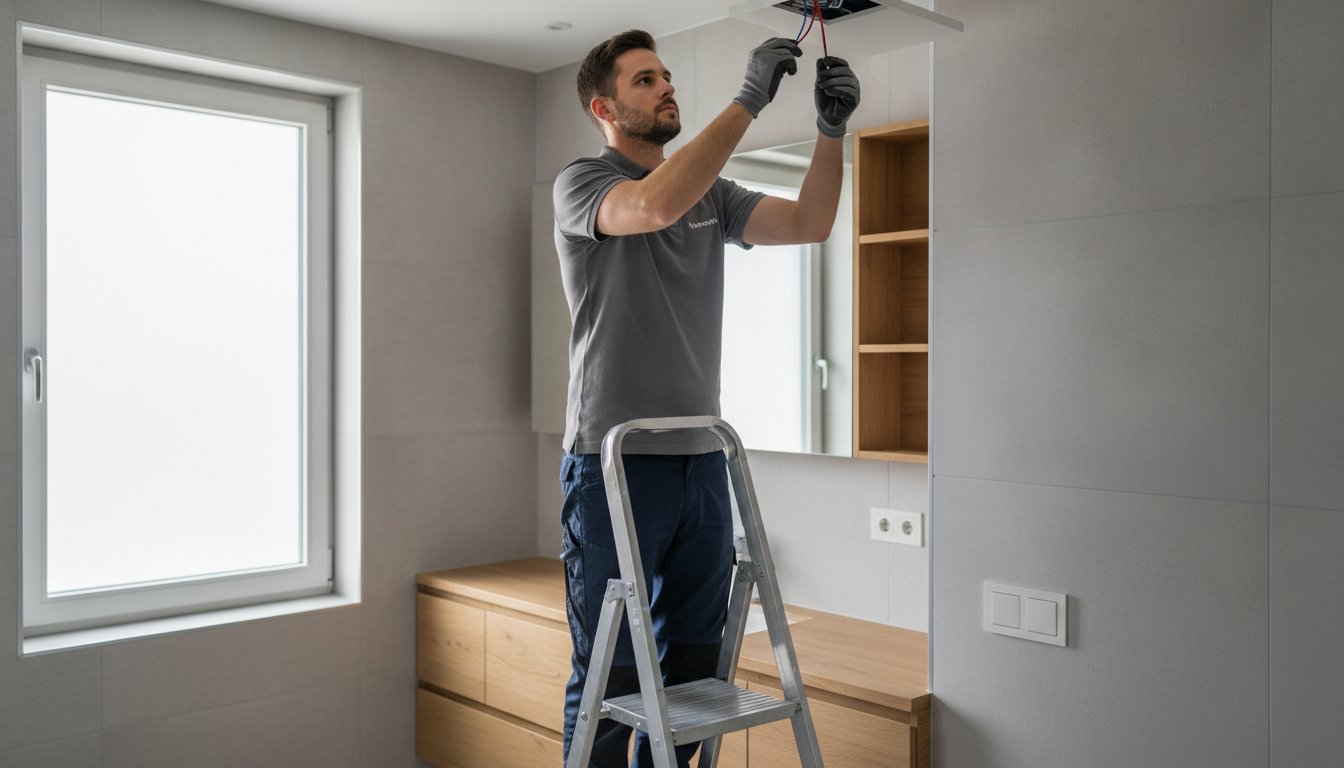
Operating an infrared panel through a wall switch is possible only if the appliance, switching equipment and complete electrical installation are suitable. An existing lighting point is not automatically a suitable heating connection. Start with a technical assessment, not by copying wire colours or a general connection example.
This guide helps you ask an installer the right questions and choose between switch, timer and thermostat. We advise private and business end users and support installers and wholesalers with suitable systems.
Key points
Check whether the panel permits external on/off control and how it restarts after power interruption. Have switch, wiring, connections and other circuit loads assessed together. Do not remove a plug without product permission or use a lighting dimmer for heating without express approval.
The basics: switching is not temperature control
An ordinary switch opens or closes a suitable supply. It does not determine whether the room has reached the desired temperature. Without additional controls, a panel may keep heating while powered. A panel also does not always become warm immediately: element and surface need to warm up. Short visits therefore require consideration of warm-up time and comfort.
If lighting and heating are linked, heating may run when only light is needed. Independent control is often more practical. A combined panel with lighting must expressly support the intended switching arrangement; one housing does not automatically mean one simple connection.
Wiring: what the installer needs to assess
The installer checks the existing circuit, actual conductor functions, protection, switching equipment and connection space. Wire colours alone do not prove function or isolation. Use the product diagram and appropriate safe-isolation procedures. This work requires competence; a short web instruction does not replace that assessment.
Do not add only lighting and panel power: identify all relevant simultaneous loads. A nominal 16 A circuit or 10 A switch does not universally permit 3,680 or 2,300 watts of heating in every situation. A total below 3,000 watts also does not guarantee a suitable existing circuit. Higher loads may require a designed relay or contactor arrangement.
Earthing and appliance class
Whether a protective conductor is needed follows the appliance class and wiring diagram. A metallic appearance alone does not determine it. Never omit required protection because a lighting point lacks that connection. Other installation requirements still apply to double-insulated models.
Choosing controls: switch, timer or thermostat
A manual switch is clear but requires deliberate switching off. A timer can limit duration. A thermostat responds to temperature and may support schedules. The permitted and useful combination depends on appliance and use. Also check whether built-in electronics resume the correct mode after external interruption.
A smart switch is not automatically a suitable heating relay. Check load type, power, behaviour on connection failure and any neutral requirement in the documentation. A home-automation protocol or app does not establish electrical suitability. Presence switching also requires a setup that remains suitable for unexpected activation.
Mounting and finishing the installation
Check panel weight, substrate and prescribed fixing method. A particular plug or cavity fixing does not suit every plasterboard ceiling. Do not add rubber washers or other materials changing mounting distance or heat resistance without manufacturer permission. Brackets and clearances are part of the approved design.
Conceal cables and connection boxes only where temperature, protection and accessibility permit. A box behind the panel may be unsuitable because of heat or lack of space. Keep the original cable and plug intact unless product instructions permit modification. Retain the diagram and have operation and protection checked before use.
Extra attention in bathrooms and kitchens
In damp rooms assess exact position and intended use, not just an IP number. Switch, receiver and connections may have different location requirements from the panel. Follow manuals to prevent water contact, covering and unsuitable heat exposure. Ventilation remains necessary regardless of switching arrangement.
The right panels and controls for your project
Share the panel model, room, photos of the intended position and desired controls. We discuss suitable use with end users and coordinate components and documentation with installers and wholesalers. Output follows heat demand, not a fixed promise that 1,000 watts always heats ten to fifteen square metres.
Start with a suitable switching arrangement
A neat finish is worthwhile when installation and controls are technically suitable too. Ask us for advice or a quote for a combination your installer can assess against the existing installation.
Frequently asked questions about panels and light switches
Can I control heating through a lighting dimmer?
Do not use that combination without explicit approval for the actual appliance and controller. A typical lighting dimmer is not a standard heating controller. Choose a documented compatible thermostat or power control and have the load assessed.
Is frequent switching always harmless?
No. Relays, electronics and connections also have operating limits. Follow permitted control methods and switching cycles. During maintenance check cable, plug or fixed connection, mounting and controls. Low maintenance does not guarantee unlimited life.