
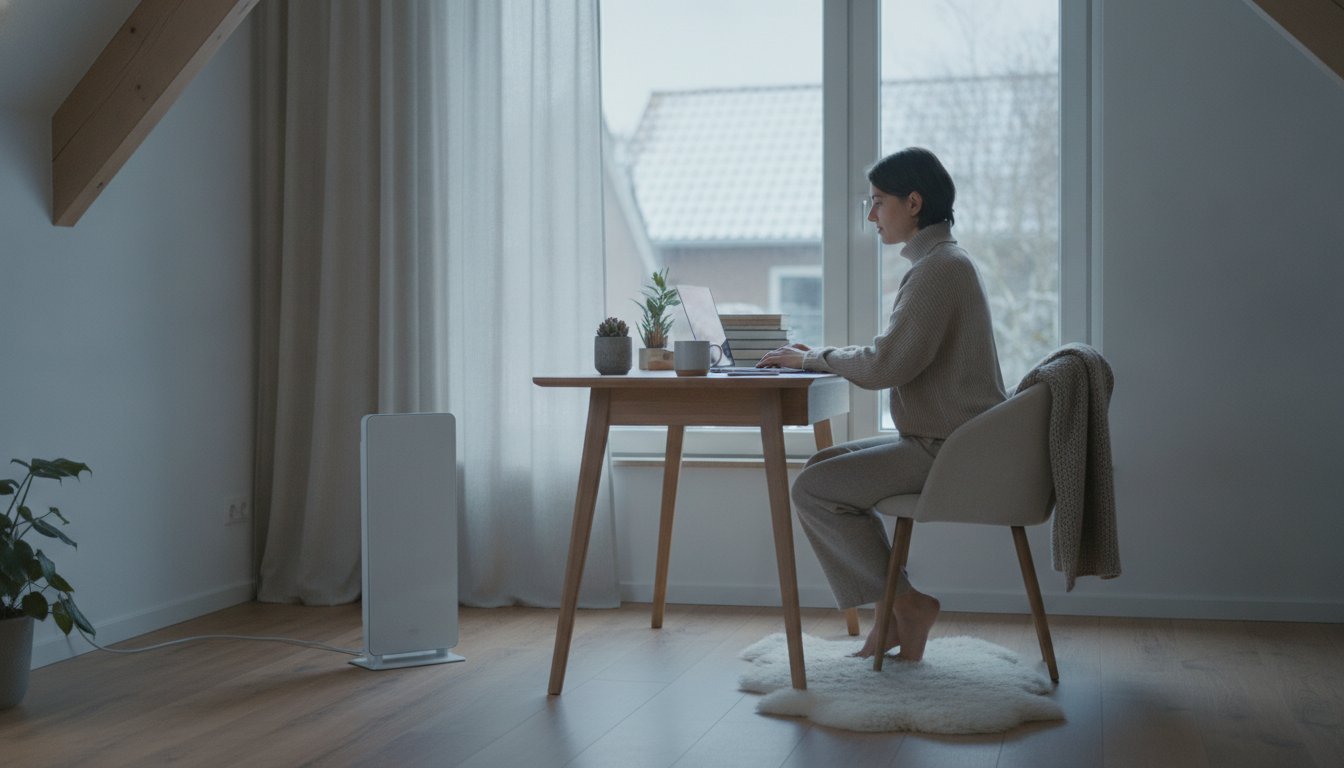
A small infrared heater is usually intended to add comfort at one spot: a desk, armchair or hobby table. The term covers different appliances, from compact panels to heaters with visibly glowing elements. They are not interchangeable. Start with the intended application and the specific model’s safe-use conditions.
This guide explains local supplementary heating, meaningful comparisons with other heaters and buying considerations. It does not assume guaranteed bill reductions. An extra appliance adds consumption unless other heating use changes appropriately.
Key points
Choose according to location and heating need, not low wattage alone. Check approved mounting or feet, clearances, controls and electrical load. Compare energy for the same comfort objective. For bathrooms, sleeping and unattended use, follow the specific permissions and instructions.
What does small infrared heater mean?
An electric element heats and emits infrared radiation among other heat transfers. People and surfaces within reach can absorb it. Convection also occurs and the air warms too. Reflectors, element temperature, panel dimensions and positioning affect the experience. A compact appliance is not automatically a substitute for full room heating.
Some panels have no fan and therefore produce no fan noise. That does not make every infrared appliance entirely silent: relays or expanding components may be audible. Warm-up time and temperature also vary. Follow the manual for positioning and operation.
Supplementary warmth where you are
Targeted warmth may be practical when one person remains seated for long periods. Check coverage and furniture obstructions. Then assess whether existing heating can be adjusted without compromising other occupants or the building. There is no universal temperature reduction that preserves comfort.
A heating panel does not treat allergies, asthma or irritated eyes. Ventilation, cleaning and moisture management remain important. Warm surfaces and stored heat do not cancel ventilation losses. Assess comfort as comfort without attaching unproven health benefits.
Comparing fairly with other electric heaters
Electric resistance appliances ultimately convert almost all electricity consumed into heat. Differences include heat distribution, control and comfort at the occupied position. Fan heaters, oil-filled radiators and infrared panels may suit different uses; no type automatically wins in every room.
A 500-watt appliance uses less electricity than a 2000-watt one for equal running time. That does not establish equal room heating or comfort. Compare actual running time and other heating use. A thermostat may alter operating time but does not guarantee fixed savings or rapid payback.
Buying and positioning: what should you check?
First decide between local comfort and full room heating. The latter requires a heat-loss assessment considering insulation, glazing, ventilation and temperature. Do not blindly add a power percentage or use a universal watts-per-square-metre rule. Ask for advice on your room if uncertain.
Check whether the model permits freestanding, wall-mounted or other use. Use only approved accessories and maintain specified clearances. Under a desk or beside a sofa is not automatically safe. Keep walkways and cables clear and never cover the appliance.
Check actual safety features, electrical load and compatible controls. Surfaces can become hot and even brief contact may burn. Prevent children or pets reaching hot parts. Bathroom use requires model approval, exact location, connection and protection together; an IP code alone is insufficient.
Advice on compact supplementary heating
We help private and business end users and also supply installers and wholesalers. Tell us where extra warmth is needed, how long you spend there and what heating already exists. Photographs or a floor plan help us advise on model, position and controls. Check warranty and documentation by version; expected life is not a warranty period.
Start with one specific comfort need
Do not choose whole-home heating based on the feeling from one small appliance. Assess larger heating plans separately. Solar panels do not automatically make supplementary heating energy-neutral either: generation and demand do not always coincide. Measure total use where possible and match controls to actual needs.
Frequently asked questions
What does one hour of heating cost?
Multiply power input in kilowatts by actual operating hours and your tariff. A 500-watt appliance running continuously for one hour uses about 0.5 kWh. A thermostat changes operating time; an active schedule does not mean continuous heating.
May it remain on while sleeping?
Do not assume this generally. Follow the exact appliance’s instructions and permitted arrangement. Overheat protection or stable positioning alone does not prove that overnight or unattended use is allowed. Do not bypass instructions with improvised timers or connections.
Is cleaning the only maintenance needed?
Follow the manual for cleaning and inspection of cable, plug, mounting and controls. Allow cooling and disconnect safely before cleaning. Do not continue using damaged equipment before assessment. Even a panel without a fan contains components that can wear or fail.