
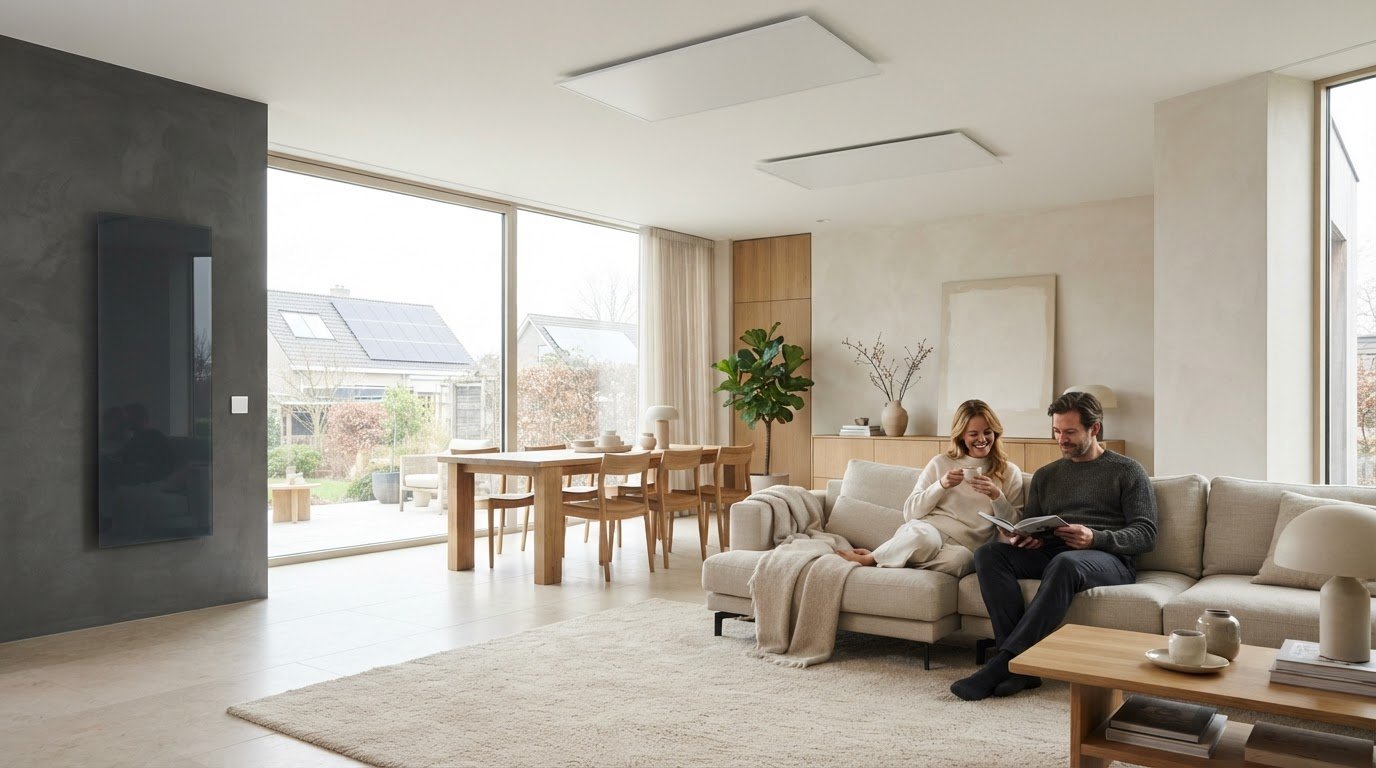
Infrared heaters come as flat panels, freestanding units and focused radiant heaters. Compare them for their intended application. A product suited to a workbench may differ from the right choice for permanent living room heating.
Key considerations
List operating hours, desired temperature, mounting locations and available electrical supply. Then compare the complete system with controls and accessories. This guide helps prepare that comparison; it does not replace heat-loss calculation or electrical installation assessment.
How do infrared heaters deliver heat?
A warm device can radiate towards people and surfaces and heat air through convection. The proportion varies by version. Conventional radiators also radiate heat. An infrared radiator therefore does not eliminate air movement, and a flat panel is not automatically technically identical to every other device with that name.
A panel needs time to reach operating temperature. Warm-up and perceived effect depend on the model, distance, surface temperatures and room. Air temperature is not the only comfort factor, but no fixed thermostat reduction guarantees the same comfort for everyone.
The marketing term heater does not establish wavelengths, surface temperature or light output. Some versions glow visibly; others have no visible glow. Even a device without light can have hot surfaces and high local exposure. Assess coverage using manufacturer data.
Distinguish performance from costs
With electric resistance heating, almost all input electricity ultimately becomes heat. This differs from radiant share or running costs. A heat pump can move environmental heat and should be assessed as a different technology. At equal heat demand and comfort, compare installation, controls, maintenance and energy too.
Radiant heat can contribute to comfort but does not guarantee dust-free air, moisture balance or treatment of allergies and asthma. Ventilation and cleaning remain necessary. Warmer surfaces can limit condensation; persistent damp also requires investigating its cause. Fixed savings or lower thermostat settings cannot be promised for every room.
Is infrared always cheaper than gas?
No. Compare total costs for the same use and comfort, using your own energy tariffs and the efficiency of the existing system. Local supplementary heating can differ from whole-room heating. A lower gas bill may accompany a higher electricity bill; assess both.
Compare different versions
A seating area, workstation, bathroom and industrial hall do not require the same version. Assess coverage and obstructions for local warmth. In bathrooms, model approval, position and electrical protection must work together; an IP code alone is insufficient. In industrial settings, dust, vapours, accessibility and special requirements also matter.
Metal, glass, mirror, printing or RAL colour are model-specific options, not universal characteristics. Check permitted wall or ceiling mounting. A mirror that helps limit condensation is not automatically sized to heat the entire room.
A freestanding device needs a stable, approved position and attention to cables, children and pets. Use a wall panel on feet only if the manufacturer permits that combination. A high-temperature patio or workshop heater is not automatically suitable for prolonged use beside a sofa.
A heated mirror can combine a mirror and heat source. Check whether the product is intended for room heating or only mirror demisting; these are different functions. Power, dimensions, connection method and optional lighting or controls vary by version.
Coordinate capacity, mounting and controls
Include heat loss, insulation, windows, external surfaces, ventilation and target temperature. A fixed wattage per square or cubic metre is not a complete calculation. More power does not automatically mean less consumption. Device count follows required output and possible locations, not a standard two or three radiators per living room.
Check substrate, load capacity, fixings and clearances according to the manual. Ceiling installation is not always best. Have a competent installer assess supply, protection and combined electrical load. A plug or wireless thermostat does not make every connection or location suitable.
Choose compatible controls, receiver and sensor location. Wi-Fi, window detection or energy monitoring vary by combination. Follow manual cleaning and inspection requirements and keep connections accessible where needed. Low-maintenance does not exclude faults, wear or replacement parts.
A thermostat usually measures temperature at its sensor position and switches or controls the system accordingly. This does not automatically regulate the panel surface temperature. Check the panel, thermostat and receiver manuals together; words such as smart or modulating are insufficient without compatibility details.
Follow the exact model’s mounting instructions and assess whether you can safely install the fixings. Substrate, weight and clearances matter. Have a competent installer assess and carry out fixed electrical connections and any installation changes. A plug does not automatically make every location suitable.
A proposal for your home or business
We supply private and business end users, installers and wholesalers. Share dimensions, photos or a plan, insulation and usage times. Include existing heating and mounting and operation preferences. We discuss suitable combinations for your building or customer project and identify technical information still needed.
Ask for product codes, quantities, thermostats, receivers, fixings and any installation work to be listed separately. Check availability, warranty terms and who handles the electrical installation. Installers and wholesalers can discuss the technical combination and project supply with us.
Assess maintenance and warranty by product
Switch off, isolate and let the device cool before carrying out maintenance as prescribed in the manual. Do not casually touch reflectors or heating elements, or use one general cleaning method for every model. Low-maintenance can still require cleaning and inspection.
Ask for the specific product’s warranty and cleaning instructions. Scratch resistance, colourfastness and lifespan cannot be promised equally for every surface. A measurement standard or environmental registration is not a general savings guarantee. Also compare installation, controls and running costs at equal comfort.
Infrared heater FAQs
How much electricity does a panel use?
A 600-watt panel operating continuously at full power for one hour uses about 0.6 kWh. Multiply actual consumption by your total electricity tariff. This is a calculation example, not a prediction of daily operating time.
Can the surface become hot?
Yes. Surface temperatures vary by version and can pose a contact risk. Choose an approved location considering children, pets and other vulnerable users. A temperature limiter does not automatically make touching safe. Do not cover the device unless expressly permitted.
Does every device last more than twenty years?
This cannot be generally promised. Lifespan depends on product, environment and use and differs from warranty. Check terms for heating element, finish, controls and accessories separately.