
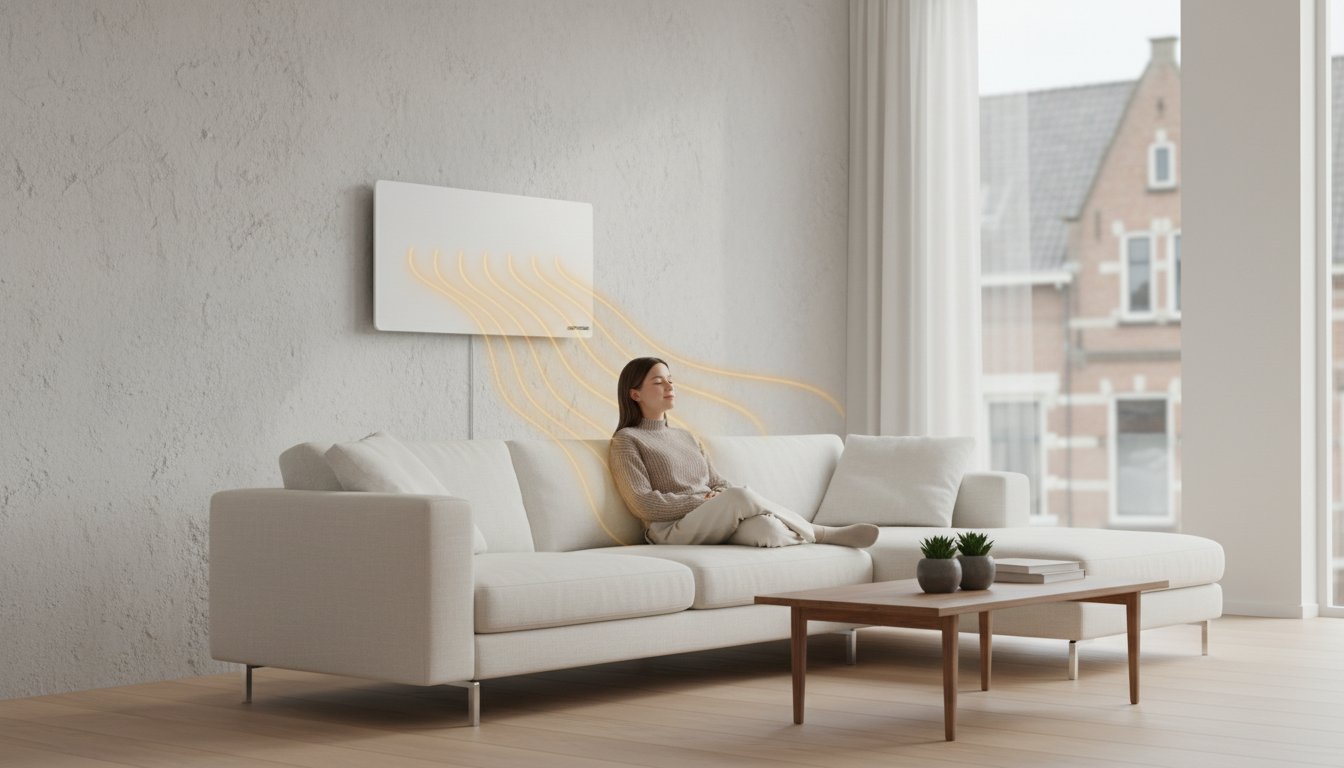
“Infrared heater” can describe different electric appliances: a flat panel for an indoor room, a targeted heater for a workstation or a patio heater. They are not automatically interchangeable. Choose the application and comfort area first, then check the model, positioning, output and controls. A general promise of efficiency or rapid warmth is not enough to choose an appliance.
Key points
Distinguish local supplementary warmth from heating a whole room. Check whether the appliance suits indoor, outdoor or damp conditions. Follow model-specific mounting and connection requirements. Compare heat delivery, actual consumption and total costs separately; no technology is automatically best for every application.
How does an infrared heater work?
An infrared panel transfers heat through radiation and also convection. Radiation can reach people and surfaces; warmed surfaces then release heat to their surroundings. A convector primarily heats air, which circulates through the room. The distinction is therefore not an absolute separation between air heating and radiant warmth.
The infrared spectrum has different bands. IR-C extends from 3 micrometres to 1 millimetre. That label alone does not establish suitability or safety for every application.
Perceived warmth depends on position, distance, surface temperature, room and person. Panels do not all warm up equally quickly or intensely. Warmer surfaces can affect comfort but do not repair a thermal bridge or insulation defect. A fixed reduction in air temperature with unchanged comfort therefore cannot be promised for every situation.
Practical features and limitations
A panel can use wall or ceiling space and support a fixed occupied area if the model is suitable for that mounting. Compatible controls let you set operating times and desired temperature. This may limit unnecessary heating, but results depend on the existing installation and actual use. Air movement and heat loss remain present with infrared too.
Electric resistance heating converts almost all input electricity into heat. This applies to infrared panels and other electric resistance appliances. The radiant share is a different quantity from total conversion into heat. A high radiant share therefore does not prove a fixed reduction in annual consumption.
A heat pump works differently: it uses electricity to move heat from the environment. Therefore, do not compare only two resistance appliances when planning heating for a whole home. Assess heating demand, performance under relevant conditions, investment, installation and running costs for each system. No form of heat delivery eliminates losses through ventilation or inadequate insulation.
Heating provides thermal comfort and does not treat allergies, asthma or other conditions. Ventilation, cleaning and addressing sources of moisture remain necessary. A different heat-delivery method should therefore not be presented as a guarantee of healthier indoor air or a dust-free room.
Compare designs and materials
Metal, glass, mirror glass, ceramic and printed surfaces differ in appearance and construction. Compare weight, dimensions, surface temperature, mounting and controls for each model. Do not assume all glass panels use the same safety glass or that one metal always performs better. Assess a rear construction or insulation layer as part of the whole appliance, not as separate proof of savings.
Emissivity, radiant share and electricity-to-heat conversion are different quantities. High emissivity does not mean the same percentage of all input energy reaches your occupied area as useful radiation. Use measurements for the exact model and avoid a general ranking based only on material or finish.
A hybrid design may combine radiant heat with additional convection. Check which components are actually present and how they are controlled. The word “hybrid” does not automatically make an appliance more efficient. A heated mirror may reduce misting in its heated area, but does not guarantee that all condensation disappears everywhere.
For an office, counter, workshop or industrial hall, assess occupied areas, mounting height, operating hours and environment. A domestic panel and an industrial radiant heater are not automatically interchangeable. Desk heating must also suit the particular position and distance. Installers and wholesalers should discuss model codes, quantities, compatible controls and project requirements.
Capacity, positioning and electrical installation
Measure length, width and height. Note windows, doors, insulation and possible draughts, together with desired temperature and occupancy times. Mark seating or work areas and available mounting positions on a plan. Photos help assess the layout and possible obstacles. A general watts-per-square-metre rule does not replace assessing heat loss.
Main heating must meet the demand of the room as a whole. For local supplementary heating, assess the occupied seating or work area alongside existing heating. One compact panel is therefore not suitable as complete room heating without assessment. Low wattage is also not proof that the desired comfort will be achieved.
Check structural support, fixings, mounting height, clearances and electrical connection. Check whether a thermostat is built in or required separately, whether it is included and what load the controller can switch. Match schedules and temperature to actual use. If uncertain, seek a competent assessment before mounting or connecting.
Have the electrical installation assessed for total and simultaneous loads, protection and connection requirements. A calculated rating for one circuit does not prove every existing installation is suitable. Do not apply universal clearances, fixed temperature limits or automatic additional output: the manual and a reasoned sizing assessment take priority.
Position the appliance for the occupied area. Furniture, high shelves and other obstacles can restrict direct radiation. Wall or ceiling mounting is an option only if the chosen model permits it. Check clearances, structural support, environment and electrical connection in the manual. Warm-up time and perceived warmth vary by model and situation; do not expect universally guaranteed instant room heating.
A suitable heating plan with us
We supply private and business end users, installation companies and wholesalers. Describe the room, existing heating, the area to warm and operating times. Include dimensions, insulation details and preferences for wall, ceiling or another version. We help compare suitable products, mounting requirements and controls.
Check compatibility between controller and appliance and which functions are actually available. Schedules, occupancy sensors, adaptive start and open-window detection may be useful, but do not work identically on every model. Detection thresholds and switching loads are product-specific. An app or energy-management link does not guarantee savings; incorrect settings can increase consumption.
Low maintenance does not mean maintenance-free. Follow the manual for cleaning and checking the appliance, fixings, connection and controls. Do not cover a heater and maintain the specified clearances. Recurring damp, mould or draughts require assessment of their cause; heating is not a general remedy for these building or ventilation problems.
We help compare products and controls for your room and use. We do not have a showroom and visits are not possible. Include dimensions, photos and relevant product or installation details with your enquiry. You can also contact us directly about a customer project or business partnership.
Choose by application and verifiable data
Compare more than purchase prices and wattages. Include controls, installation, maintenance, energy tariffs and the overall heating arrangement. Electric supplementary heating is not automatically cheaper than gas heating or a heat pump. The outcome depends on the systems and the heat demand you actually replace or add.
Solar panels change the cost calculation, but do not generate enough electricity at every heating moment. Consider simultaneous generation and demand, winter use and contract terms. Dutch net metering ends on 1 January 2027; do not calculate future consumption as if annual generation and use could be offset without limit.
Infrared heaters: frequently asked questions
How much electricity does a 600-watt appliance use?
One hour of continuous operation at rated full output uses about 0.6 kWh. Multiply actual kWh by your electricity tariff. Under thermostat control, operating time depends on heat demand, settings and conditions. A fixed 15–20 minutes per hour does not apply to every room.
Can I install every panel myself?
No. The manual, connection, mounting position and your competence determine what is possible. A plug-in model has different connection requirements from fixed wiring. Have unclear mounting or electrical situations assessed and do not modify the product outside the manufacturer’s instructions.
Are hot surfaces safe to touch?
An operating panel can become hot. Do not promise that brief contact cannot cause injury. Check the model’s surface temperature and instructions, prevent unintended contact and consider children and other vulnerable users. The mounting position must meet all appliance requirements; ceiling mounting is not automatically permitted for every model.
What happens after switching off?
The appliance cools down and surfaces already warmed may continue to release heat. How quickly the room cools depends on the building, temperature, ventilation and use. There is no general guarantee that infrared warmth remains longer after switching off than heat from every other system.