
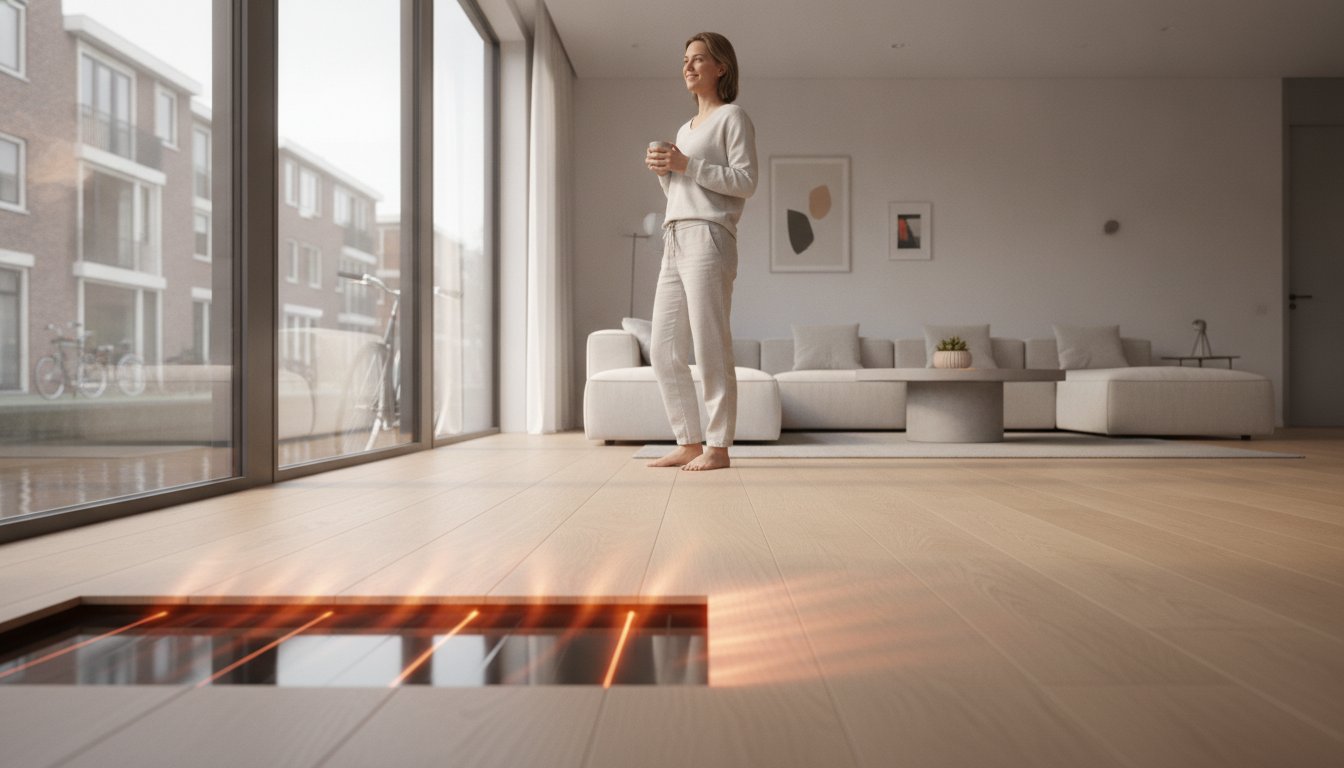
Illustration: the floor cutaway is schematic. The actual layer build-up follows the chosen system’s manual.
Infrared underfloor heating is a term for electric floor solutions, including heating film. For a good choice, complete floor construction matters more than the label. Read how to assess floor finish, controls and electricity consumption together in renovation and new construction. This text helps preparation; your own system’s design and manual remain decisive for installation.
Key points
Choose a combination of underlay, heating and finish permitted by the manufacturers. Have heat demand and electrical connection assessed. Available floor area and permitted floor temperature help determine how much heat the system can release.
How does infrared underfloor heating work?
Electrical resistance in film or cable converts electricity to heat. Heat travels through floor layers to the surface, mainly by conduction. The warm surface then releases heat to the room through radiation and convection. Radiation from the film therefore does not pass unhindered through the floor directly to occupants or furniture.
Film and cable systems mainly differ in construction and permitted application. Some films are intended for dry build-ups under floating floors; certain cables or mats are embedded in suitable adhesive or levelling layers. The product manual determines possibilities. Do not treat these system types as interchangeable parts.
Infrared underfloor heating: build-up height and response time
The film itself may be thin, but total height also includes insulation, protective layers, any load-spreading layer and finished flooring. Check doors, thresholds and adjoining floors against the whole build-up. An existing floor surface must also be sufficiently flat, dry and load-bearing for the chosen system.
Response speed depends on output, floor layers and the amount of material heated. A thin dry system may react differently from a thick screed, but no fixed warm-up time can generally be given. Match schedules to the response actually measured in your room.
Insulation remains important
Suitable insulating underlay can reduce downward heat flow but does not eliminate building heat loss. Shiny foil alone does not guarantee sufficient insulation. Assess thermal resistance, compressive strength and suitability of all layers together; heat must still pass effectively through the finished floor.
Which floor finish is suitable?
Laminate, wood or PVC is not automatically suitable because its packaging says “underfloor heating”. Check that both flooring and heating manufacturers permit this specific electric build-up. Maximum temperature, thermal resistance, underlay and laying method must match. A fixed 27 °C limit does not necessarily apply to every product.
Include fixed furniture, kitchen units, rugs and other coverings in the laying plan. Install heating only where permitted by the manual and prevent heat build-up. A floor sensor and suitable limitation matter but do not replace a correct laying plan. Wet rooms require express suitability of the complete system; ordinary dry heating film is not automatically suitable.
Installation, controls and electricity consumption
Required output follows from heat loss and available heated floor area, within system temperature limits. Standard watts per square metre give insufficient certainty for primary heating. Also have circuit loading, protection and connection of thermostat and any switching components assessed.
Cutting, connecting, sealing and sensor placement must strictly follow the chosen version’s instructions. Not every film may be cut or connected in the same way. Do not overlap strips and prevent damage while laying the finish. Have prescribed electrical checks performed before, during and after work and retain the laying plan.
A correctly set thermostat monitors temperature and can schedule use. A floor sensor limits the floor according to product specifications; a room sensor can additionally control room temperature. Wifi, self-learning features and dynamic-tariff control are not present in every thermostat and do not guarantee savings themselves.
Comparing consumption and costs
An installation drawing 1 kW continuously for one hour uses 1 kWh. Annual consumption depends on on-time, heat loss and set temperatures. Compare purchase, installation and running costs with alternatives, including a heat pump. Solar panels can help during simultaneous generation but do not automatically make winter heating cheap or energy-neutral.
Assessing your heating plan together
We advise private and business end users, installation companies and wholesalers. Share a floor plan, floor construction, insulation details and intended use. We then discuss whether heating film, another floor system or panels fit better. When combining systems, controls must prevent unnecessary simultaneous heating.
A complete choice for your building
Request a quotation clearly stating included layers, control components, connection work and checks. Discuss warranty and component access in a later fault. For a fully gas-free solution, include domestic hot water and cooking. Any subsidies or tax benefits must be checked for the actual investment; do not count them as certain beforehand.
Frequently asked questions
Is it suitable as primary heating?
This depends on calculated heat demand and the heat the available floor can release within all temperature limits. Good insulation alone is not a complete assessment. Have output, floor finish and electrical capacity checked together.
Is the system maintenance-free and will it last a lifetime?
No, such a general guarantee is not justified. Follow use and inspection instructions and account for the lifespan of thermostat, connections and sensors. Expected technical lifespan is not a warranty term.