
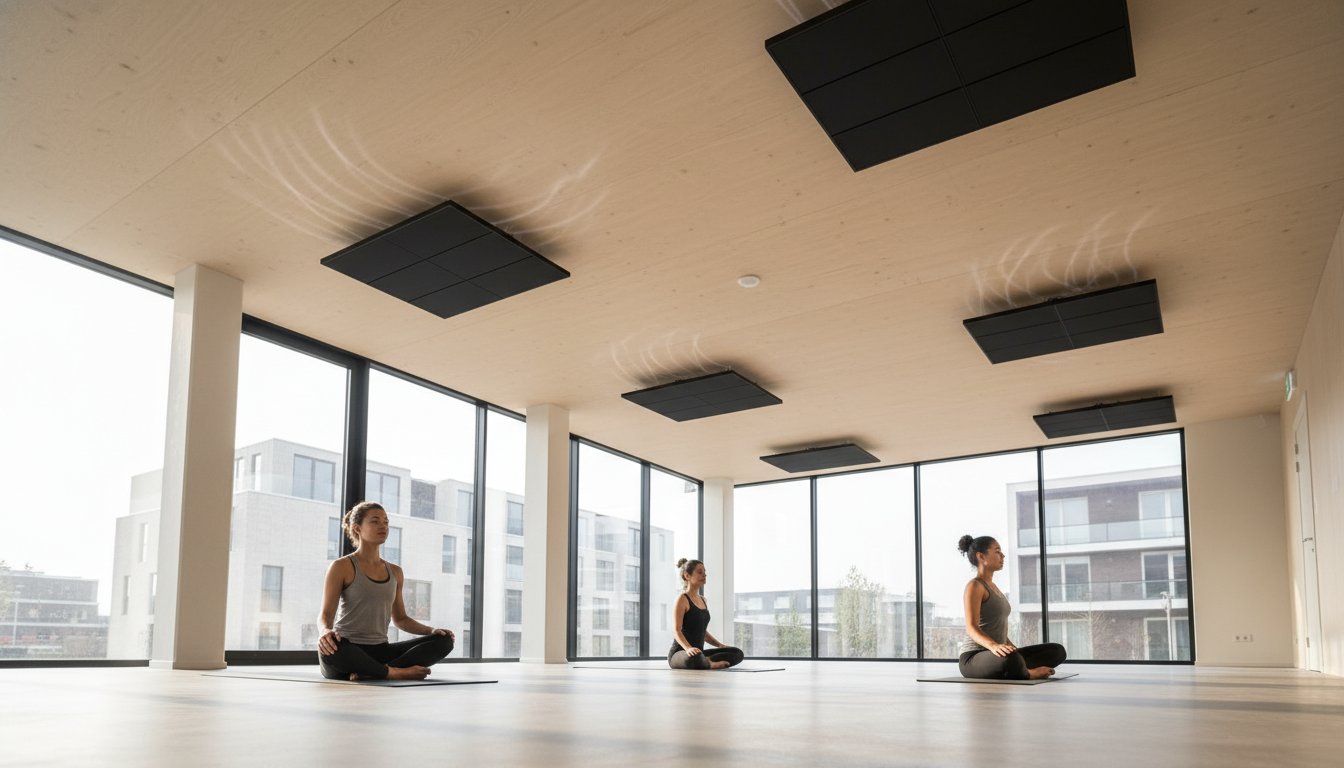
For hot yoga, heating must form part of a coordinated indoor-climate plan. Class format, participants, ventilation, humidity and heat distribution all need attention. A particular panel temperature or a “hot yoga” label does not prove an appliance suitable for your studio.
Key points
Design for actual class conditions and check results at several positions. Keep product safety separate from sporting or health advice. Heating does not guarantee flexibility, injury prevention or healthy skin.
Class conditions start with the brief
Define which spaces are heated, occupancy and the conditions required by the class format. Do not use one universal temperature as safety advice for every participant. Ventilation and humidity management must suit occupancy and use; heating does not compensate for inadequate fresh air.
Wavelength does not guarantee comfort
Infrared panels release heat through radiation and convection. Received radiation depends partly on distance, angle, shielding and posture. High emissivity is not the same as low consumption. Long-wave radiation does not provide general permission for unlimited exposure either; the exact appliance’s instructions remain decisive.
Select for the permitted application
Compare versions for permitted environment, dimensions, weight, mounting and controls. A hotter panel is not automatically better, and a domestic panel is not automatically suitable for a heated exercise studio. Check the temperature and moisture conditions permitted by the manufacturer. An IP44 or IPX4 code alone does not establish full resistance to studio humidity or corrosion.
Design, mounting and commissioning
Have heat loss and ventilation needs assessed using the plan, insulation, height, occupancy and class schedule. Then determine capacity and positions. Check the supporting structure and follow model-specific distances from participants, ceiling, combustible materials and other installations. A general 20–30 cm clearance or 2.5-metre mounting height is not a safe universal rule. Have electrical capacity and controls assessed too.
Before regular use, test distribution, measurement positions, controls and warm-up under representative conditions. Assess different postures and mat positions. A ceiling grid does not guarantee equal exposure for every participant. Record settings, inspection and maintenance and revisit the plan when layout or occupancy changes.
Our product advice for your studio
We advise private and business end users and support installers and wholesalers. Share room data and the class concept for a proposal. Agree who assesses and handles heat loss, ventilation, structure, mounting and connection. Without these inputs, no fixed warm-up time, class cost or target temperature can be promised.
Compare the complete system
Compare heating options for the same class conditions and ventilation. Use power, actual operating hours and tariffs and include installation, controls and maintenance. Electrical conversion to heat is not the same as a cost advantage over gas or a heat pump.
View project heating · Discuss your yoga studio
Frequently asked questions
Is infrared beneficial for sensitive skin? This is not a general space-heater property. Feeling warm or the absence of UV does not establish suitability for every participant. Follow appliance instructions and keep health questions separate from product advice.