
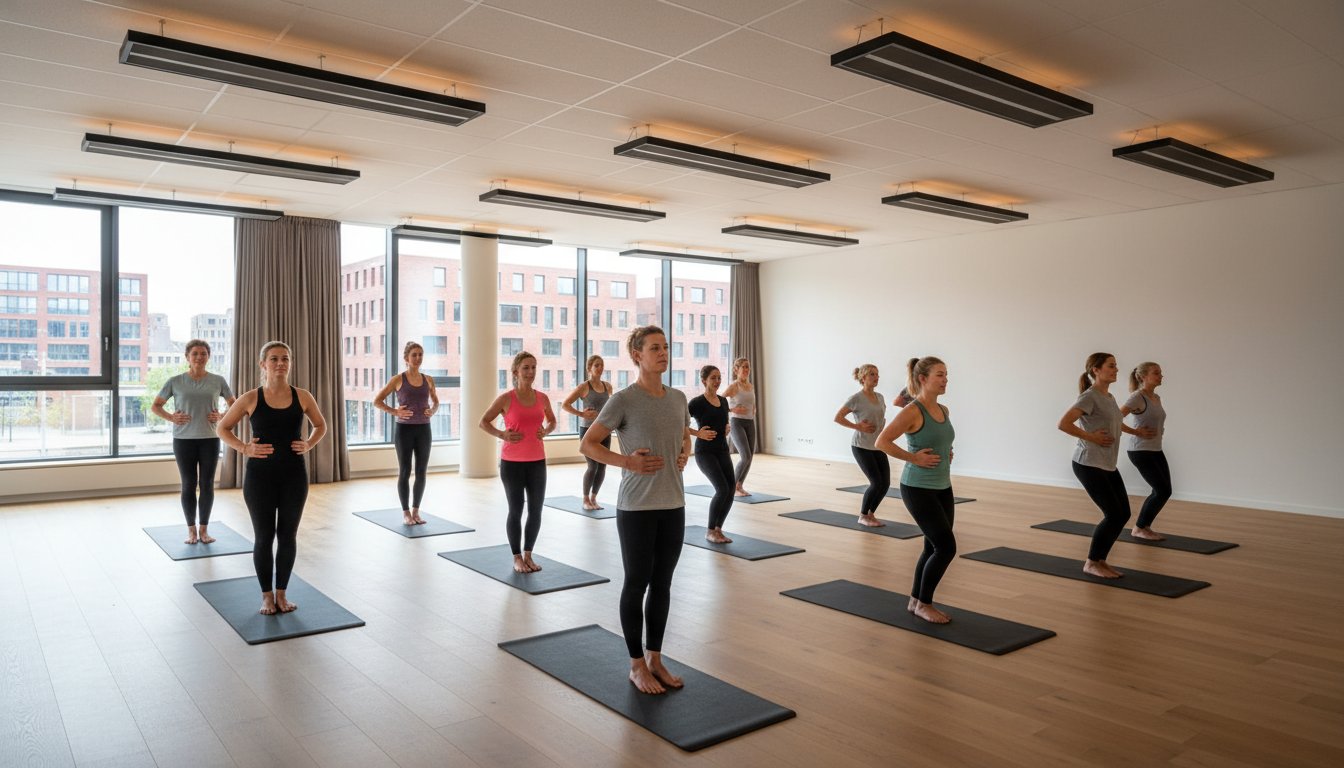
Hot Pilates places particular demands on indoor conditions. Intended class conditions, occupancy, ventilation and participants’ movements must be assessed together. Infrared panels may form part of a studio design, but high panel power or surface temperature does not guarantee a suitable training environment.
Key points
Separate heating design from sporting and health promises. A space heater is not intended to prevent injuries, heat muscles deeply or accelerate recovery. First define the required conditions and responsibilities.
What does an infrared panel do in a studio?
A panel releases heat through radiation and convection. People and surfaces within range may receive warmth, while the air also warms. Received radiation depends partly on distance, angle, posture and obstacles. Panel temperature is not the same as air or perceived temperature at a mat.
Assess comfort and air quality together
An occupied studio still needs ventilation, moisture management and cleaning. Infrared does not make the air dust-free or prevent dry eyes or allergies. Coordinate heating and ventilation rather than restricting fresh air to keep the room warmer. The studio sets its class policy; a product description does not establish a universally safe training temperature for all participants.
Design capacity and distribution
Gather the floor plan, ceiling height, insulation, glazing, ventilation data, occupancy and class schedule. Have heat loss and required warm-up behaviour assessed. A fixed number of panels for 50 m² or a universal watts-per-cubic-metre rule is not a final design. Assess warmth at several mat positions and postures so one measurement point does not hide uneven exposure.
Compare consumption and alternatives
Compare options for the same class conditions, occupancy and ventilation. Electric resistance heating ultimately converts electricity almost entirely into heat; this does not prove infrared is always cheaper than a heat pump or existing system. Use actual power, operating hours and tariffs and include installation, controls and maintenance. Warm-up time between classes cannot be guaranteed without project data.
Select appliances, mounting and controls
Check whether the model is permitted for the intended environment and operating temperatures. Have the supporting structure, fixings, clearances and electrical capacity assessed. Plasterboard or standard ceiling profiles are not automatically sufficient for every panel. Match sensor position, thermostat and protection to the design. An IP44 rating alone does not prove general moisture or corrosion resistance.
A studio proposal that can be checked
We advise business and private end users and support installers and wholesalers. Share room data and the class concept for a product proposal. Agree clearly who handles calculations, ventilation design, installation and commissioning. Assess final operation before regular classes and follow the model’s inspection and maintenance requirements.
View project heating · Discuss your studio project
Frequently asked questions
Is a higher temperature always better? No. The intended class environment and suitable equipment must be assessed together. Participant exposure cannot be inferred from panel surface temperature or wattage alone.
Does infrared prevent muscle injuries? This cannot be promised as a space heater feature. Feeling warm is not evidence of deep muscle heating, improved sporting performance or faster recovery.