
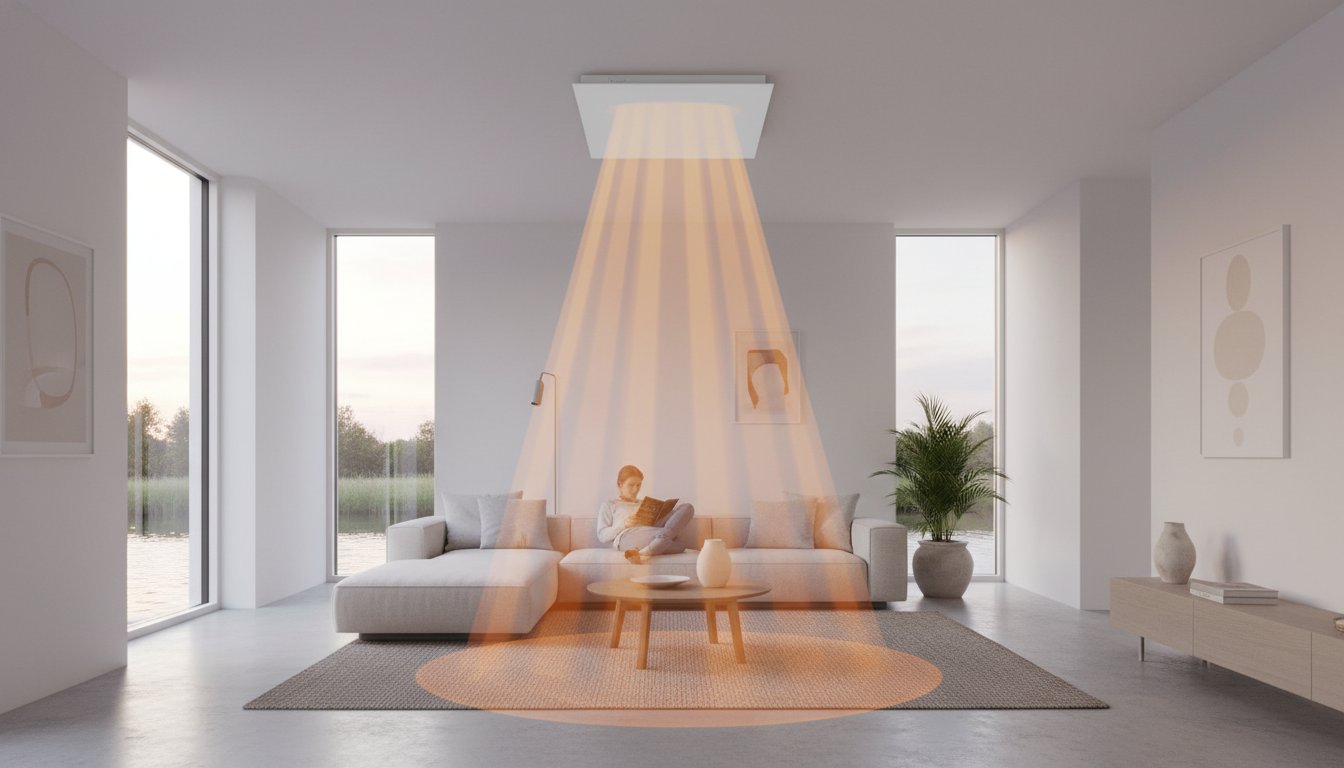
Start with the exact panel, an approved layout and clear controls. Check appliance and control manuals first. Then adjust programmes and temperature to when and where heat is needed, without assuming a universal schedule for every home.
Key considerations
Maintain required clearances, prevent covering and check controls. Assess comfort at occupied spots. Compare actual consumption under similar conditions; smart functions or a high radiation share do not guarantee savings.
Assess heat and use
Panels emit radiant and convective heat. Exposed surfaces may absorb and later release energy. Warm-up and residual warmth vary by appliance and building. No fixed equivalence links a lower infrared setting to a higher boiler temperature. Air movement, ventilation and heat loss remain.
Maintain a suitable layout
Keep furniture and curtains from covering appliances or obstructing radiation excessively. Consider distance, direction, people and hot surfaces. Wall or ceiling mounting needs exact-model approval. Generic output-height tables or centimetre gaps are not installation instructions. Recheck the layout after moving furniture.
Programmes, sensors and zones
Select compatible thermostats and receivers and verify actual functions. On/off control is not automatically unsuitable, and modulation is not always possible. Position sensors representatively as instructed. Set schedules for actual needs and assess one change at a time. There is no universal night setback, ideal temperature or absence threshold for shutdown. Maintain necessary building conditions and frost protection.
Adapt to the room
Bathrooms require suitable positions, products and electrical protection together; an IP rating alone is insufficient. Heated mirrors cannot remove moisture or automatically prevent mould. Assess seating in living rooms, work areas and extraction in kitchens, and beds and accessible hot parts in bedrooms. Motion sensors can miss seated users. Coordinate supplementary and existing heating.
Maintenance and consumption
Clean only as instructed after safe shutdown and cooling. Check fixings, cables, visible damage and controls. Follow specified batteries and maintenance intervals, not generic replacement schedules. App readings are not automatically genuine energy measurements. Compare measured consumption with hours, weather, settings and other heating; an increase does not immediately prove faults or changed panel efficiency.
Advice on changes or expansion
Share models, settings, plans and your comfort question. We support private and business end users, installers and wholesalers with information and quotations. Assess capacity from heat loss and use. Solar panels do not make heating automatically free or carbon-neutral. Low maintenance is not maintenance-free; lifespan and warranty differ.
Frequently asked questions
Continuous operation or shutdown depends on the building, use and comfort goal. Warm rooms do not require the same operating time everywhere. Apps, geofencing, window detection and consumption displays require explicit support. Do not bypass protection after faults; have recurring problems assessed. Existing sockets or extra output do not automatically fix unsuitable installations.