
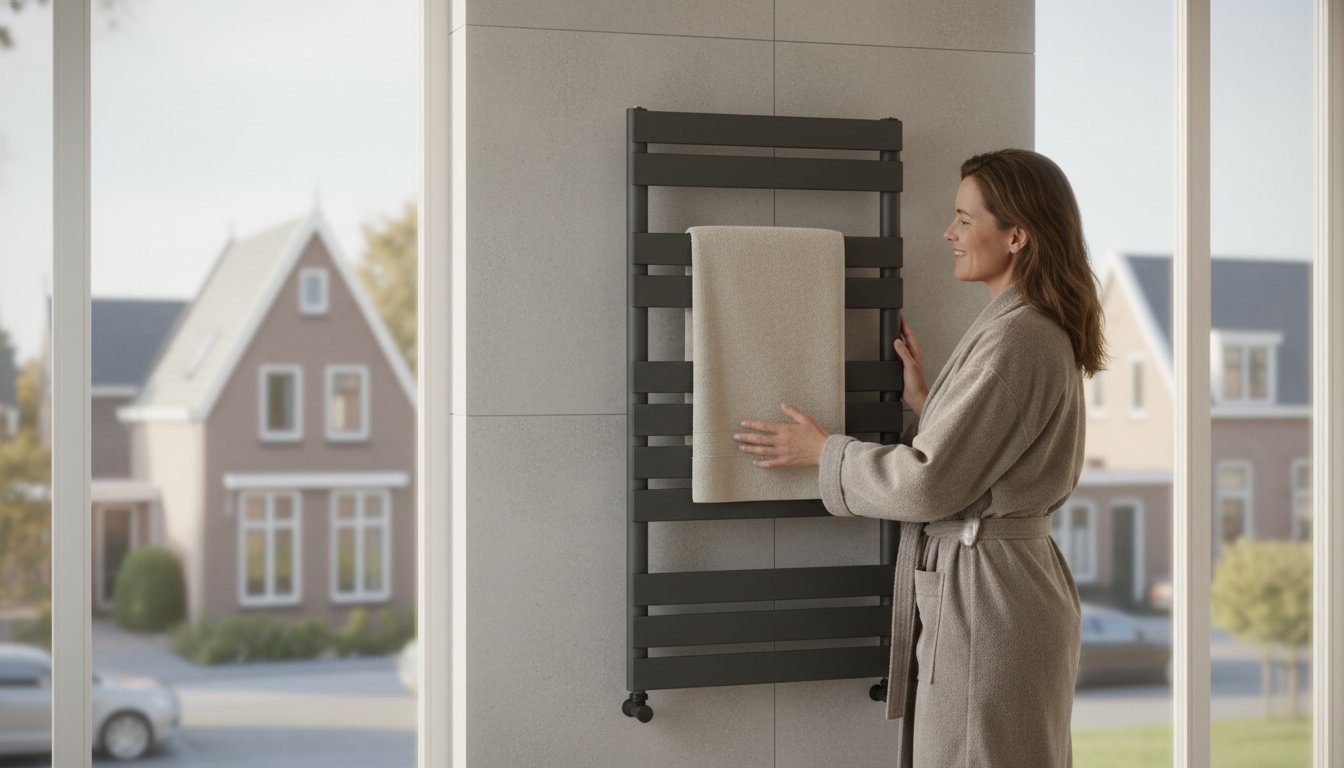
Choosing a towel radiator starts with two questions: warm or dry towels, and heat the bathroom too? Not every dryer performs both adequately. Check model purpose and output and assess room demand before replacing an existing radiator.
Key points
Compare constructions and permitted towel loads. Towels can reduce room heat output. Plan mounting, controls and moisture management together. Warm towels or a water-free heater do not automatically mean low costs or a dry bathroom.
Distinguish functions and versions
Electric products include liquid-filled units, dry elements and panels with purpose-designed rails. Response, controls and conditions differ. Independent operation may allow summer use where installed accordingly, without proving lowest-cost primary heating.
Check supply scope and required controls. Rails may fit only specific panels. Adding arbitrary brackets or covering ordinary panels is not equivalent. Follow load, distance and textile instructions.
Heat for towels and room
Warm surfaces deliver radiation, convection and sometimes contact heat. Proportions vary. Liquid-filled radiators also radiate, and infrared panels also convect. Compare actual performance rather than treating technologies as mutually exclusive.
Hang textiles as instructed and preserve permitted air and heat paths. Thick or multiple towels may change distribution. Include normal towel use when sizing room heating. Uncovered-product data do not automatically describe loaded performance.
Size from heat loss, ventilation, temperature and primary or supplementary role. Area or building-age rules are insufficient. Towels and the whole room need not reach comfort simultaneously.
Comfort without health or damp promises
Warm or drier towels may feel pleasant, but evaporation adds moisture to air. Provide ventilation or other assessed removal. Radiators are not dehumidifiers, disinfectants or mould treatments. Investigate persistent damp causes.
Heating provides comfort, not treatment for respiratory conditions. Ventilation, cleaning and maintenance remain. Warm surfaces may condense less in suitable conditions but guarantee no dry walls or joints. Assess mirror, light and drying functions separately.
Safe, usable mounting
Assess model, moisture, position and full connection together. IP alone does not approve a bathroom position. Choose fixings for actual wall and loaded weight, hidden services and waterproofing.
Choose accessible height while meeting clearances. Preserve doors and routes. The heater is not a grab rail. Brief hot contact can injure; consider children and vulnerable users.
Use compatible controls and test routines. A towel timer and room thermostat may serve different jobs. Check sensors and power failure. Coordinate other bathroom heating to avoid conflict.
Advice on appliance and supply
We advise private and business end users and support installers and wholesalers. Share layout, existing heat and towel use. We discuss models and parts. Materials, finish, warranty and availability are product-specific, without a general lifespan promise.
Compare purchase, works, power, controls and maintenance. Calculate actual power-time consumption with your tariff. Price or solar does not prove low total costs. A towel radiator does not automatically make a whole home gas-free.
Commission and maintain
Check normal comfort and towel use. Follow model cleaning and checks: electric radiators have different internal construction. Assess looseness, glass damage, leaks or faults before reuse. Retain settings and documents.
Towel radiator questions
Can it be the only bathroom heater?
Only if designed and sufficient for room demand under normal towel load. Assess before removing heating. The term towel dryer does not prove room capacity.