
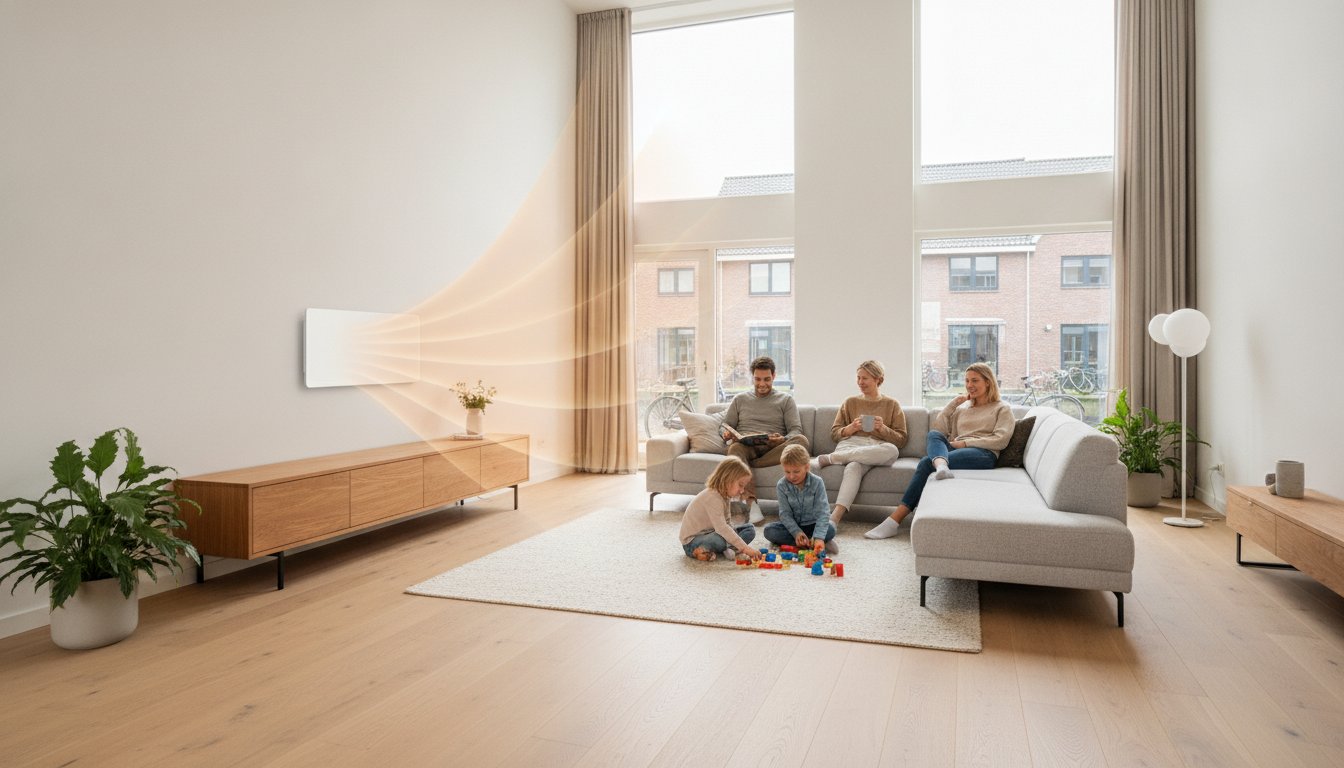
The image is an illustration. The added heat beam clarifies the principle; infrared radiation itself is not visible.
Low-cost heating without gas requires comparison of investment and annual costs. The lowest purchase price is not always the most economical choice over the whole operating period. This guide helps build a budget for insulation, heat source, controls and installation, with a realistic role for infrared panels.
Key points
First reduce heat demand where worthwhile. Compare several complete solutions using your own energy prices and usage. Include domestic hot water, cooking and supply capacity. Do not assume fixed heat-pump prices, household consumption or guaranteed payback periods not based on your situation.
Low-cost heating without gas: what should you include?
Establish whether you want to improve one cold spot or heat an entire home without gas. A small supplementary appliance and a complete primary system are different investments. Also compare insulation measures and better controls for existing equipment; replacement is not the only way to limit costs.
Use current contract tariffs and quotations. Taxes, subsidies and local plans may change and do not automatically make any product group economical. Fixed gas costs only disappear after actual termination of the connection under applicable conditions. Also check hot-water and cooking solutions.
What infrared heating does and does not change
An electric infrared panel emits radiant and convective heat. Targeted radiation may feel pleasant at a seat or workstation. The panel does not improve home insulation or prevent ventilation losses. Heat stored in walls or furniture is previously supplied energy, not a new source.
For supplementary heating, assess added electricity alongside actually avoided primary-heating use. A lower gas bill alone does not prove lower total costs. For primary heating, the system must cover each room’s heat demand with suitable controls and connection.
Comparing panels and heat pumps in full
A heat pump can transfer ambient heat and therefore need less electricity for the same heat supply than direct resistance heating. Required investment and alterations vary by building and type. There is no universal installation price or annual consumption for a corner house. Request comparable quotations.
Compare these five cost categories over the same operating period:
- Purchase: equipment, controls, receivers and other required parts.
- Installation: mounting, wiring and any alterations to the connection or heat-emission system.
- Energy: expected electricity use with your contract tariff and substantiated operating hours.
- Maintenance: prescribed checks, cleaning and any servicing.
- Replacement: components or appliances needing replacement within the chosen period.
Substantiate replacement intervals with product data and identify assumptions. Limited maintenance needs do not offset every electricity-consumption difference without calculation. Also document assumptions about future tariffs.
Solar panels can cover simultaneous use. Account for investment and export value; winter heat demand does not always coincide with generation. Your own solar electricity does not eliminate higher heat demand or guarantee free warmth or short payback.
A phased approach for the home
Start with building-envelope information and current consumption. Then define each room’s objective and have suitable capacity assessed. Panel output cannot be linked to standard floor area without heat-loss assessment. Also assess available electrical capacity during simultaneous use.
A local trial can provide useful comfort information but does not prove the same costs apply to the whole home. Measure under comparable conditions and record settings. For complete primary heating, compare a whole season and demand in all used rooms.
For wall or ceiling mounting, distance, fixings and orientation follow the model manual. In a bathroom, appliance and position must be assessed with electrical protection. No mounting form automatically guarantees a warm floor or absence of cold zones.
Our advice for a suitable budget
We help private and business end users, installers and wholesalers. Send a floor plan, insulation details, existing installation and operating times. We help consider suitable products and controls. Ask about the complete proposal and conditions so you know which parts and work are included.
Substantiating affordability rather than promising it
Choose a solution matching building, use and budget. Check documentation and warranty and include cleaning, inspections and possible repairs. Origin, high price or expected lifespan do not prove low total ownership costs.
Frequently asked questions about affordable gas-free heating
Is a subsidy available?
This depends on measure, location and current conditions. Have the administering body confirm eligibility before including a subsidy in calculations. An application route for another heat source does not mean an infrared panel receives the same support.
What should I do about domestic hot water?
Room panels do not heat domestic water. A fully gas-free plan therefore requires a separate suitable solution and attention to cooking. Assess purchase, capacity and running costs of these parts together with space heating before terminating the connection.