
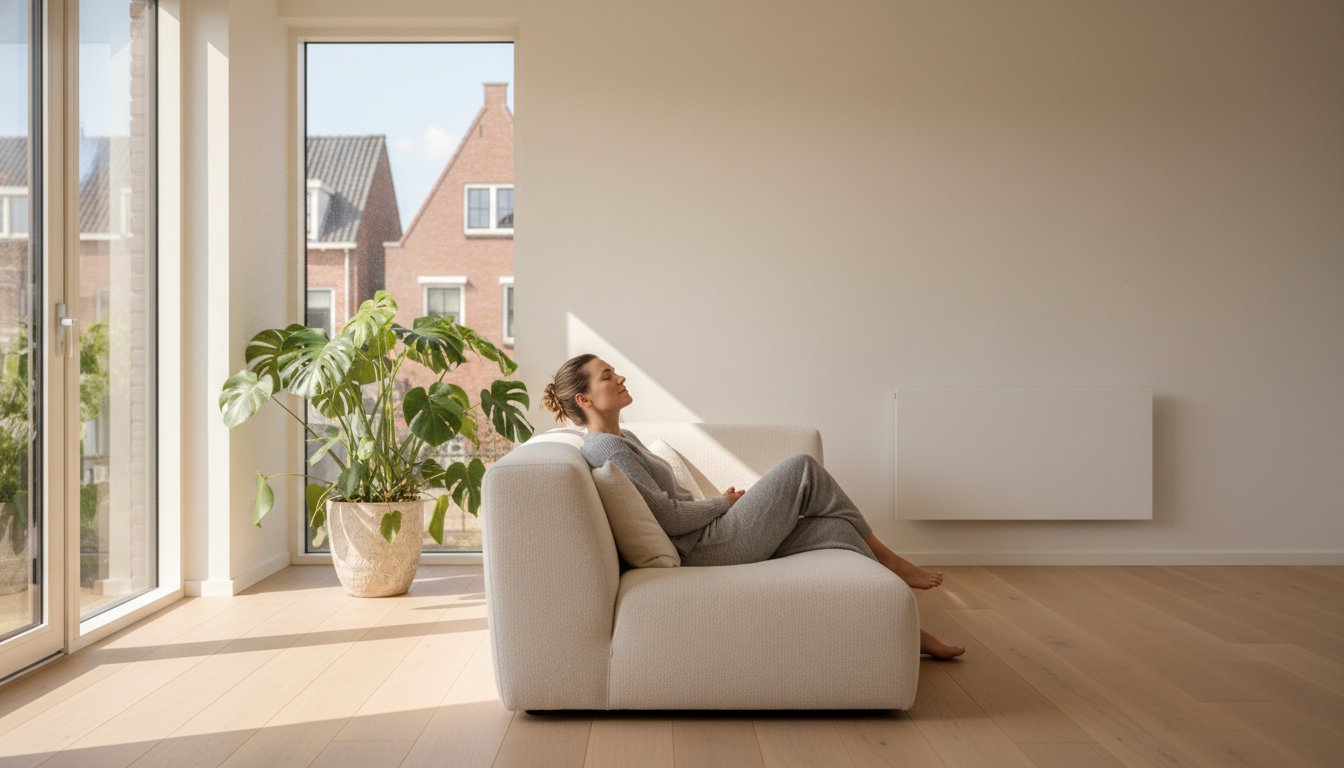
Humidity and heating together affect how comfortable a room feels. Ventilation, dust and the position of a heat source also play a part. This article separates how heating works from claims about dry or stinging eyes. A heating panel is a comfort product, not a medical device.
Key points
A heater does not automatically add moisture to the air or remove it. Warming air without adding water vapour can lower relative humidity, regardless of the type of heat source. Infrared does not prevent this or guarantee that symptoms will disappear.
Humidity and heating on a cold day
Cold outdoor air and heated indoor air have different temperatures. Relative humidity describes the amount of water vapour present compared with what is possible at that temperature. That percentage can therefore change without a radiator extracting water from the air. Measure temperature and humidity together instead of identifying one heating system as the cause.
Stinging eyes do not, by themselves, prove that a radiator needs replacing. This article does not diagnose conditions, and a panel should not be chosen as a treatment. If eye symptoms persist, consult your GP. Thuisarts provides information about dry eyes, possible causes and when to seek advice. Heating product advice is not a substitute for this.
What changes when you heat air?
A heated room can have a suitable indoor climate with either radiators or infrared. The balance also depends on ventilation, moisture production, outdoor temperature and use. There is no basis for a general claim that convection makes a healthy indoor climate impossible or that infrared preserves a natural moisture balance.
Even a panel without a fan causes natural convection. “No fan” is therefore not the same as no air movement or no airborne dust. Ventilation, cleaning and reducing dust sources remain necessary. Do not choose a heat source on the promise that pollen or eye irritation will disappear.
Infrared and thermal comfort: what can you expect?
A panel delivers radiant heat to people and surfaces within its reach, as well as convective heat. The sensation at a seating area or workstation can therefore differ from that of another heat source. Whether a lower air temperature remains comfortable varies by room and user. A fixed reduction of two or three degrees is not a general product performance claim.
Heat loss, output, positioning and controls remain important for a suitable installation. Our information about infrared heating in the living room addresses that technical choice without promising medical results. Radiant heat does not eliminate a room’s heat losses. Even a heated wall can still become damp when conditions allow. Persistent damp or mould requires investigation and cannot be resolved with a product promise.
Practical points for everyday use
Measure in a representative location and observe changes over several days. Do not place sensors directly beside a hot surface, window or moisture source. Assess changes one at a time so you can see what temperature, ventilation and use alter. A single isolated measurement does not fully assess the indoor climate.
Choose controls that limit unnecessary heating hours without losing the desired comfort. The sensor must measure representative conditions. An app or thermostat does not provide humidity control unless the selected system actually offers that function. Nor should you assume that displayed consumption is always measured directly.
We advise you on output and positioning
We help private and business end users, installation companies and wholesalers choose heating. Share a floor plan, insulation details and how you use the space. We can then discuss output, positioning and controls on the basis of comfort and technology, without promising medical results.
An informed choice for thermal comfort
Compare installations for the same heat demand and operating time. Include electricity costs, connections and maintenance. A panel can become hot and must be installed and cleaned according to its manual. Medical applications of other infrared equipment are not evidence of health effects from space heating.
Frequently asked questions
Does infrared mean I no longer need humidification or ventilation?
No. The panel does not control humidity and does not replace a ventilation system. Whether another measure is needed depends on the measured conditions and their cause. Changing the heat source alone does not guarantee a change in humidity or personal symptoms.
Are there bathroom panels that prevent stinging eyes?
This is not a substantiated general product function. Choose a bathroom panel according to heat demand, permitted mounting location and electrical suitability. Mirror heating can warm the mirror, but it is not a treatment for eyes or general humidity control for the bathroom.