
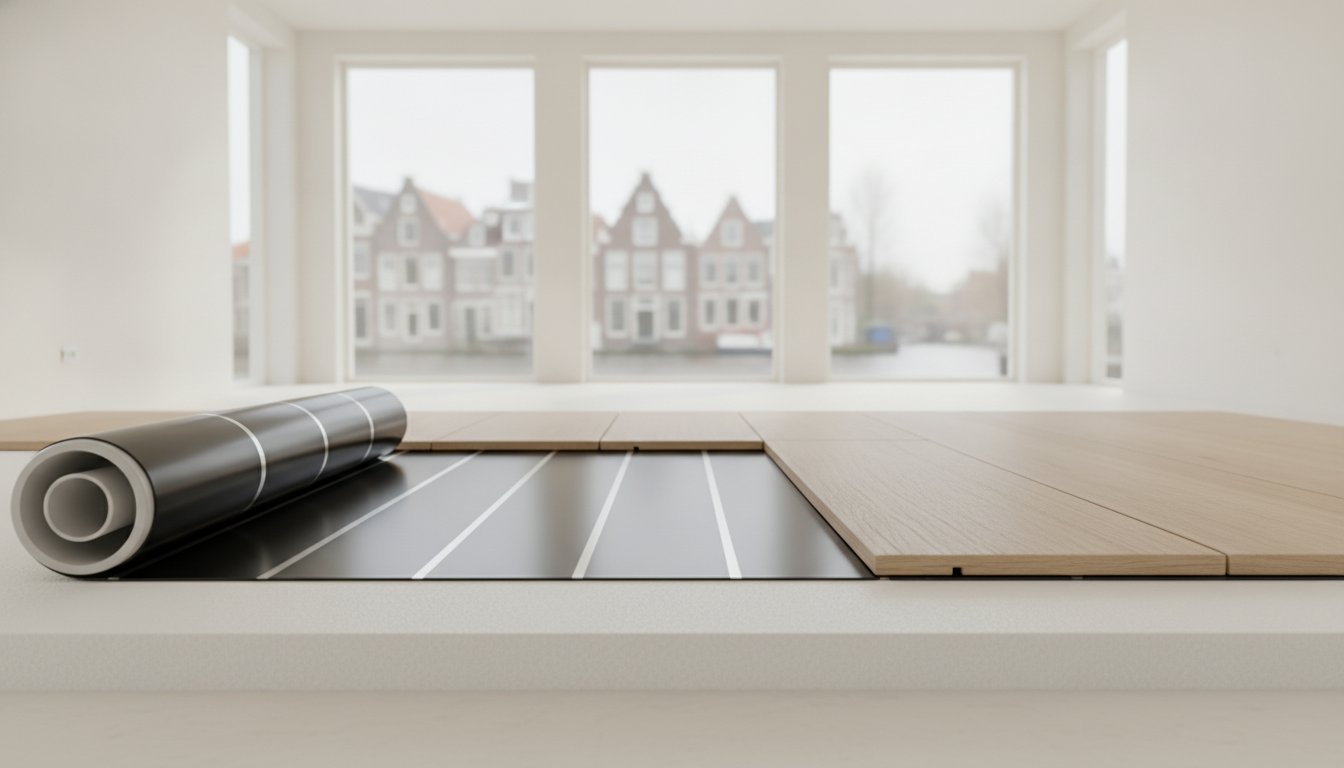
Electric underfloor heating film can be a thin heat source in an approved floor construction. The film alone is not the complete floor. Protective layers, underlay, connections and finish together determine height and suitability. Check the entire system before expecting renovation without threshold or door changes.
We discuss questions for different finishes, installation preparation and required checks. Private and business end users, installers and wholesalers can contact us to coordinate products and documentation.
Key points
Choose one documented, approved build-up. Check flooring type, temperature limits, thermal resistance and load distribution. Film beneath a floor heats the floor layers first, not people directly through the finish. Damage requires switching off and assessment, not merely checking whether other strips still heat.
What is electric underfloor heating film?
A film system contains electrically heated parts, for example carbon strips between protective layers. Construction and connections vary by product. Heat transfers through adjacent floor layers to the surface, which then releases energy into the room through radiation and convection. The word infrared does not make insulating layers above the heater unimportant.
Dry construction and build-up height
A dry-installation system may avoid wet screed work. This does not make every substrate immediately suitable: flatness, moisture and load capacity still need assessment. Repairs, load-distribution layers or protection may be needed. Ask for a full section including connections; sub-millimetre film says nothing about total height.
Technical properties and comparison with other systems
Compare film, cable mats and water-based floor construction for the same demand and finish. None of these names guarantees uniform temperatures or no hot spots. A dry system may respond differently from thick screed, but warm-up also depends on insulation, mass and controls. Choose for the actual application.
Output, consumption and primary heating
Installed watts per square metre are a product property, not every room’s calculated demand. For primary heating, output within floor-temperature limits must cover heat loss. Fixed 80 or 120 watts per square metre does not guarantee this. Costs depend on total power, actual operating time and tariff; solar panels do not automatically cover winter use.
Suitability for different floor finishes
Check approval from both heating and flooring suppliers for the complete combination. An underfloor-heating symbol or thin finish is insufficient. Underlay, protection and top layer must together meet permitted thermal resistance and mechanical requirements. Do not add layers based on a general internet tip.
Laminate and parquet
Wood-based floors respond to heat and moisture. Ask for the maximum temperature, measurement location and heating procedure. 28°C is not a universal limit for all wood or laminate. Total thermal resistance and laying method matter too. Use suitable floor sensing and limits according to both sets of requirements.
Click vinyl, sheet vinyl and carpet
Soft or thin finishes may require specific load distribution and protection. An arbitrary protective board does not automatically make film suitable for carpet or vinyl. Ask for the approved full build-up for your exact product, including point loads and thermal resistance. Click vinyl also needs suitable flatness and support for joints.
Preparing and checking installation
Prepare a plan of heated zones, fixed furniture, connections, cables and sensor. Follow restrictions for rugs, cupboards and insulating covers. Check moisture, flatness and substrate capacity. The manufacturer determines insulation and protection; one board type is not standard for every system.
Shortening and connecting must follow the manual with prescribed connectors and sealing. Not all films or cable sections may be cut. Sensor location depends on system and measurement purpose. Do not apply a universal rule to put it between strips or under the element. Record required checks and measurements before closing the floor.
Electrical assessment and first heating
Have power, circuits, protection and thermostat output assessed by a competent installer. Fixed 3600-watt or 30-square-metre limits do not determine every installation’s necessary changes. Check sensor faults and temperature limits at commissioning and follow the flooring’s prescribed heating procedure.
Our advice on a complete floor solution
Send flooring brand and type, dimensions and intended build-up. We discuss products with private and business customers and coordinate components and documentation with installers and wholesalers. Ask about supply, warranty and repair; origin alone does not prove the full combination suitable.
Check requirements before closing the floor
A documented plan and suitable combination let you check the design beforehand. Ask for advice or a quote to coordinate with flooring supplier and installer, including controls and limits.
Frequently asked questions about electric heating film
What should I do about a hole or damage?
Switch off and have the damage assessed before further use or closing the floor. A damaged strip can mean more than a cold patch; insulation or connections may be affected. Remaining heat does not prove safe operation. Use only a repair method permitted for the specific product.
Is film maintenance-free and guaranteed to last as long as the floor?
There is no universal twenty-to-thirty-year or floor-lifetime guarantee. Follow checks for controls, connections and sensors and keep installation records. Expected life, heating warranty and flooring warranty are separate conditions. Discuss repair access beforehand because the heating is less accessible after installation.