
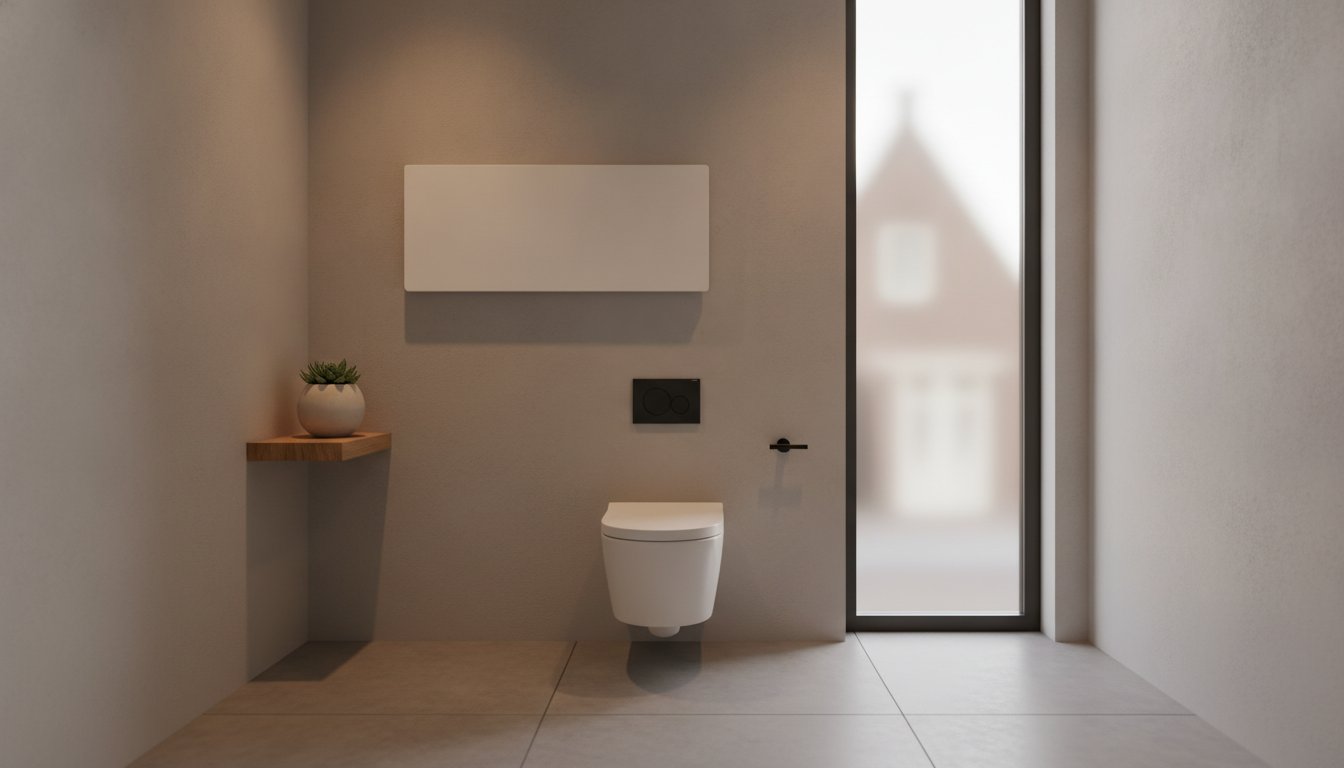
A cold toilet room can be unpleasant, but the answer is not automatically the most powerful electric appliance. The room is small, visits are short and wall or ceiling space is limited. First decide whether you want to maintain a background temperature or add warmth during use.
We discuss electric options for homes and business washrooms. Private and business end users, installers and wholesalers can discuss suitable appliances, positions and controls with us.
Key points
Small dimensions do not establish room heat loss. Consider external walls, glazing, ventilation and appliance warm-up time. A motion sensor does not automatically deliver warmth within a brief toilet visit. Mounting and electrical protection must suit the actual location, including near the hand basin.
Why consider electric heating in a toilet room?
An electric appliance needs no central-heating pipe to the heat source and may help where a water radiator is absent. A new power point or wiring changes may still be needed. An existing water radiator need not be unsuitable or slow: first assess whether balancing, insulation or different settings solve the issue.
Short visits and background temperature
A room and ceramic toilet do not warm instantly when a panel switches on. For comfort on entry, match scheduling or background temperature to actual warm-up time. Continuously heating more may use more energy than expected. Balance convenience against total operating time instead of assuming a permanently warm seat.
How infrared heating works in a toilet room
A panel releases heat through radiation and convection. People, tiles and other surfaces can absorb radiation and exchange heat with their surroundings. This does not prevent heat loss through external walls or ventilation. Nor does it guarantee even temperatures in every corner.
Almost all electricity consumed by a resistance heater ultimately becomes heat in the room. Radiant fraction and comfort at a specific position are separate questions. A panel is not automatically more economical than every other electric heater. It also removes neither moisture nor dust: cleaning, ventilation and addressing moisture sources remain necessary.
Electric options for your toilet room
A compact wall or ceiling panel may use little space. A convector has different requirements for free airflow and positioning. Electric floor heating needs a suitable construction and temperature limits. Compare options by available space and intended use, not just label wattage.
Combining a mirror and lighting
A mirror panel can combine two wall functions if designed for room heating. A demisting film is not the same as a complete heating panel and does not guarantee a permanently clear mirror. With a lighting panel, both heat and light must suit the position. Check separate operation to avoid heating when only light is needed.
Determining output and position
Measure length, width and height and note external walls, glazing and ventilation. Use these for heat-loss assessment and determine temperature and operating hours. A fixed 60–100 watts per cubic metre or a 300-watt example is not a universal result. More power does not automatically lower consumption.
Follow the model’s mounting method and clearances. Doors, cupboards or partitions may block direct radiation. Ceiling mounting must suit product and substrate and is not the best choice in every toilet room. Prevent accidental contact with hot surfaces and retain access for cleaning and maintenance.
Hand basin, connection and controls
Have the electrical installation and position near water assessed for the actual room and product requirements. Have the required protection determined from the model, exposure and complete connection. A competent installer checks wiring and circuit load.
A thermostat measures at its own location: select a representative point, not beside the heat source or in a draught. Match schedules to use and warm-up time. For timers or occupancy sensors, check compatibility and behaviour after power failure. Manual adjustment helps when use changes.
Our support for toilet-room heating
Using photos, dimensions and intended use, we discuss options. For homes and business premises we assess comfort, available space and controls. We support installers and wholesalers with product information and project coordination. Stock, colours and warranty vary by product and are confirmed in the proposal.
Choose a solution suited to brief visits
Ask us for advice or a quote aligning appliance, mounting and controls. You can then assess comfort in the smallest room together with actual running costs.
Frequently asked questions about toilet-room heating
Are running costs always low?
No. A 300-watt panel running continuously at full power for two hours uses approximately 0.6 kWh. Different schedules or greater heat loss change operating time. Calculate using actual use and your tariff, not an assumption of only a few minutes per hour.
Is a small panel touch-safe and maintenance-free?
Not automatically. Hot surfaces can burn; consider children and other vulnerable users. Follow clearances and requirements and do not cover it. Also follow cleaning and checks of cable, fixings and controls. Expected lifespan does not replace warranty terms or maintenance.