
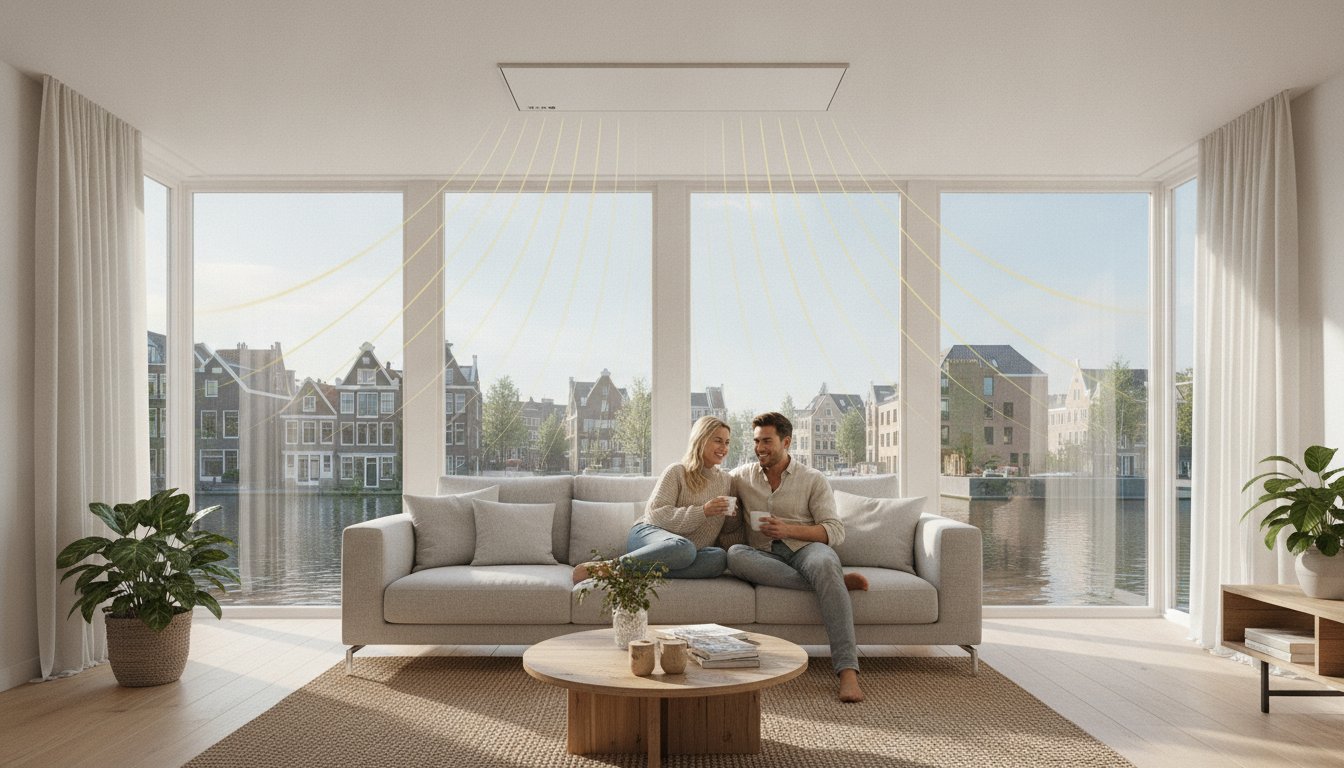
Illustration: the yellow lines show the heating principle schematically. Infrared radiation itself is not visible.
Electric infrared heating can provide targeted heat for a seat, a separate room or a carefully designed whole heating system. Whether the application is comfortable and affordable depends on heat demand, operating hours, placement and controls. A gas-free heat source alone does not guarantee a low energy bill.
This guide examines operation, comparison with other systems and the requirements for good design. We support private and business end users, installation companies and wholesalers in choosing a suitable solution. For a completely gas-free home, hot water and cooking must also be considered separately.
Electric infrared heating in brief
A panel releases heat through both radiation and convection. Heated surfaces temporarily store heat but do not form a loss-free battery. Compare systems for the same comfort demand, calculate required output and check the electrical installation. Use model data and the manual for mounting and controls.
Operation and role in a gas-free heating plan
An electric heating element warms the panel. Its surface radiates energy towards surfaces and people in its line of sight; the panel also heats air by convection. Radiators likewise release both radiant and convective heat. Differences include temperature, surface area, placement and the distribution of heat transfer.
A resistance panel converts almost all input electricity to heat at the point of use. This does not mean it needs less electricity than every other electric system. A heat pump transfers ambient heat and can therefore deliver several units of heat per unit of electricity. The final comparison requires a calculation for the building and actual use.
Solar panels and using energy at the right time
Your own solar electricity can cover part of consumption when generation and heat demand coincide. Heat demand is often high precisely when solar production is limited. Account for seasons, grid imports, export terms and your own tariffs. Extra preheating may increase heat loss; thermal mass does not make that energy free.
Radiant heat, thermal mass and placement
Walls, floors and furniture can absorb some received heat and release it later. The amount stored and rate of release depend on material, mass and temperature differences. Ventilation and heat loss through the building envelope remain. Even with infrared heating, the installation needs enough output to replace those losses.
Perceived comfort relates to air temperature, surrounding surface temperatures, air movement, clothing and activity. A well-positioned radiant source can feel pleasant locally, but a fixed thermostat reduction of, for example, two degrees is not a general promise. Assess comfort at the actual seat or workstation and adjust controls accordingly.
A ceiling position can leave wall space free and offer useful line of sight to the occupied zone. Wall mounting may suit another room better. Check ceiling height, furniture, distances and the panel’s permitted orientation. Glass and screened areas require design attention; do not assume heat passes unobstructed through furniture or building elements.
A fair comparison with other heating systems
Compare investment, electricity or fuel, necessary alterations, maintenance and operating duration. Keep building, heated zones and comfort level equal. Comparing a panel at one desk with central heating for the whole building does not provide a general savings factor. A central heating system can also be zoned with suitable provisions.
Electric boiler and heat pump
An electric resistance boiler and a resistance panel both make heat from electricity. Pipework, controls and operating strategy may influence the result; pipe heat within the heated building envelope is not always entirely lost. A heat pump has a different operating principle. For primary heating, have annual energy demand, seasonal efficiency, heat delivery and installation costs calculated side by side.
What does this mean for the indoor climate?
A panel without a fan creates no forced airflow, but natural air movement and dust remain. Heating can change relative humidity. Infrared heating does not treat allergies, asthma, pain or circulation problems. Warmer surfaces may reduce condensation under certain conditions; persistent moisture problems require ventilation, moisture reduction and addressing the cause.
Electric infrared heating: application and installation
Start with the room and how it is used. In a living room, both seating positions and desired room temperature matter. Local supplementary heating may suit a workstation if other conditions remain comfortable. A photo or coloured panel changes the design, but required capacity and permitted installation remain technical choices.
Bathrooms have additional conditions for placement and electrical connection. An IP code alone does not prove every position suitable. Have the exact version, position and controls assessed. A heated mirror can help reduce condensation on its surface, but does not guarantee a condensation-free bathroom or replace ventilation.
Use a heat-loss calculation for primary heating. Factors include insulation, glazing, external surfaces, ventilation, desired temperature and design outdoor temperature. Fixed watts per square or cubic metre do not replace that calculation. Then distribute capacity across suitable positions and check that occupied areas are adequately reached.
Have a qualified installer assess simultaneous output, circuits, protection, wiring and the main supply. Extra circuits or a different connection are not needed in the same way in every situation. Follow the product manual for fixings, load-bearing capacity and clearances. A suspended ceiling or existing lighting point is not automatically suitable for the weight or electrical load.
Controls and suitable design with our advice
A suitable on/off thermostat can control a panel well. Extra functions are useful only if they match use. Check output type, switching capacity, receiver and compatibility of the exact combination. Position the temperature sensor representatively, away from direct radiation or draughts. The manual determines possible settings and mounting.
Set a practical schedule for each room and allow for warm-up time. A motion sensor does not guarantee immediate comfort on arrival. Wifi, Zigbee, app control, consumption measurement and offline operation vary by model. Check these functions beforehand and also test the response after a power cut or lost connection.
The next step towards a suitable gas-free plan
Send us dimensions, operating times, desired temperatures and information about insulation and the existing installation. Photos or a floor plan help discuss mounting positions and sight lines. We can review a separate room, business project or supply request from an installer or wholesaler with you. Only then assess capacity, controls and a complete cost estimate.
Frequently asked questions
Is infrared heating cheaper than gas?
The system name does not establish this. Calculate electricity consumption as kilowatts multiplied by actual on-time, then by your tariff. Compare with the complete alternative for the same use, including efficiency, fixed costs and investment. Lower nominal output does not automatically mean less energy for the same heat demand.
Can it provide primary heating in an old house?
This must be assessed against heat loss, available electrical capacity and acceptable running costs. High losses may require substantial electricity. Also investigate insulation measures and alternatives. Construction year alone does not determine suitability.
How does it differ from a radiant heater?
A non-glowing panel generally has a different intensity and distribution from a glowing patio or workstation heater. Wavelength, temperature, reflector and design all play a role. Choose according to permitted application, distance and comfort; a type suitable for a terrace is not automatically suitable beside indoor seating.
What about lifespan and maintenance?
Lifespan and warranty vary by product and component. A panel with few moving parts still requires cleaning and inspection according to the manual. Check fixings, cables and controls and have damage or unusual behaviour assessed. Include receivers and thermostats in cost estimates too.