
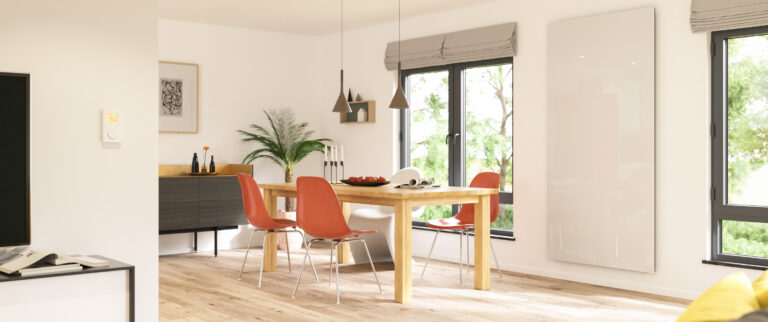
A review of electric heating panels is useful only when specific products are compared for the same task. This article is a selection guide, not a report of our own comparative laboratory test. We explain the model data, installation conditions and usage measurements needed to assess infrared panels and convectors fairly.
The balance may differ for a living room, home workstation or business space. We discuss options with private and business end users and support installers and wholesalers. The right conclusion follows from desired heat, available positioning and total costs, not brand or the word infrared alone.
Key points
Compare the same comfort, room and period. Separate electrical conversion from heat distribution. Check controls, mounting, service and measurement method. Without a substantiated product test, no fixed savings percentage, doubled wattage requirement or longer life for an entire product group can be promised.
The basics: electric heat and heat distribution
A resistance panel and electric convector convert nearly all input electricity into heat at the point of use. Both emit radiant and convective heat, with distribution depending on design. Not all electrical systems have equal energy performance: a heat pump moves ambient heat and can deliver several units of heat per unit of electricity.
For local comfort, what matters is whether heat reaches the occupied seat or workstation. Primary heating must cover the full intended demand. Furniture, airflow, insulation and control strategy affect results. Warming walls or furniture does not eliminate ventilation loss or prove panels always require half a convector’s output.
Preparing a fair practical comparison
Specify beforehand the comfort performance being compared and where measurements are taken. Keep outdoor temperature, ventilation, occupancy and hours as comparable as possible or demonstrably correct for differences. Measure all relevant energy, including heating that remains running. A short demonstration or one measured warm spot is not an annual consumption forecast.
Alongside energy, assess warm-up, local intensity, ease of use and possible controller or relay sounds. A fanless panel may still make component or expansion noises. Do not compare the first feeling of warmth with a fully heated room, and include any residual heat after switching off.
Indoor climate and safety
Neither technology is medical treatment or a ventilation replacement. A fanless appliance does not remove dust. Warmer surfaces can limit condensation in some conditions but do not repair structural damp or thermal bridges. Follow product conditions for hot surfaces, clearances, children and vulnerable users.
Comparing Adax convectors and our infrared panels
A brand comparison needs model numbers on both sides. Without a selected Adax version and specific panel, we cannot reliably judge element construction, controls, sound or lifespan. Use current documents for both and retain output and application differences. For Adax consult the official manuals by series and controller version. For our panel use its product data and manual; features of one model do not automatically cover the whole brand.
A convector may suit room-temperature requirements; a panel may suit a specific targeted sensation. Both need sufficient capacity and proper controls. Neither automatically wins above a fixed ceiling-height threshold. For primary heating compare other suitable systems too, including heat pumps where technically and financially appropriate.
Metal, glass and mirror: compare the version
Material determines appearance and some construction, but the complete build determines behaviour. Ask about weight, permitted mounting, warm-up and model surface temperature. Emissivity differs from the whole appliance’s radiant share and proves no fixed electricity costs. For measured claims ask about model, report and method. IEC 60675-3:2020’s public description concerns radiant performance, not your annual bill. Ceiling panels offer no universal 360-degree radiant angle.
For bathrooms assess mirror or glass version, position and electrics together. An IP code does not authorise every location and heated mirrors do not guarantee condensation-free rooms. For hybrids compare specified radiant and convective action; the name proves no advantage for poorly insulated homes.
The best choice follows the application
Start with heat-loss assessment and occupied-area layout. Then check mounting, supply and controls. Compare investment and calculated or measured annual energy on equal assumptions. Lower wattage is no saving if the room stays cold; a dearer version does not prove a better result.
Include cleaning, checks, warranty and possible replacement. Expected life is not a warranty term, and fanless products may still need maintenance or service. Do not compare whole groups with unproven twenty- or thirty-year claims or an assumed shorter competitor lifespan.
Discussing your product comparison with us
Send the models you compare and information on room, insulation, use and mounting positions. We discuss it with you and, where appropriate, installer or wholesaler. Ask for a clear proposal naming the version and conditions. This lets you assess cost and comfort without assuming a universal winner.
Frequently asked questions
Is a panel review enough to choose heating for my whole home?
No. A review replaces neither heat-loss calculation, electrical assessment nor design for every room. Hot water and cooking also belong to a full gas-free transition. Use comparisons for focused questions and have the complete plan matched to your home.
How do I compare electricity costs?
Multiply actual input in kilowatts by operating hours and your tariff. Use suitable measurement or a traceable estimate for equal comfort. Programmed thermostat time is not automatically heating time and apps do not always show measured use. Include fixed costs and installation separately.