
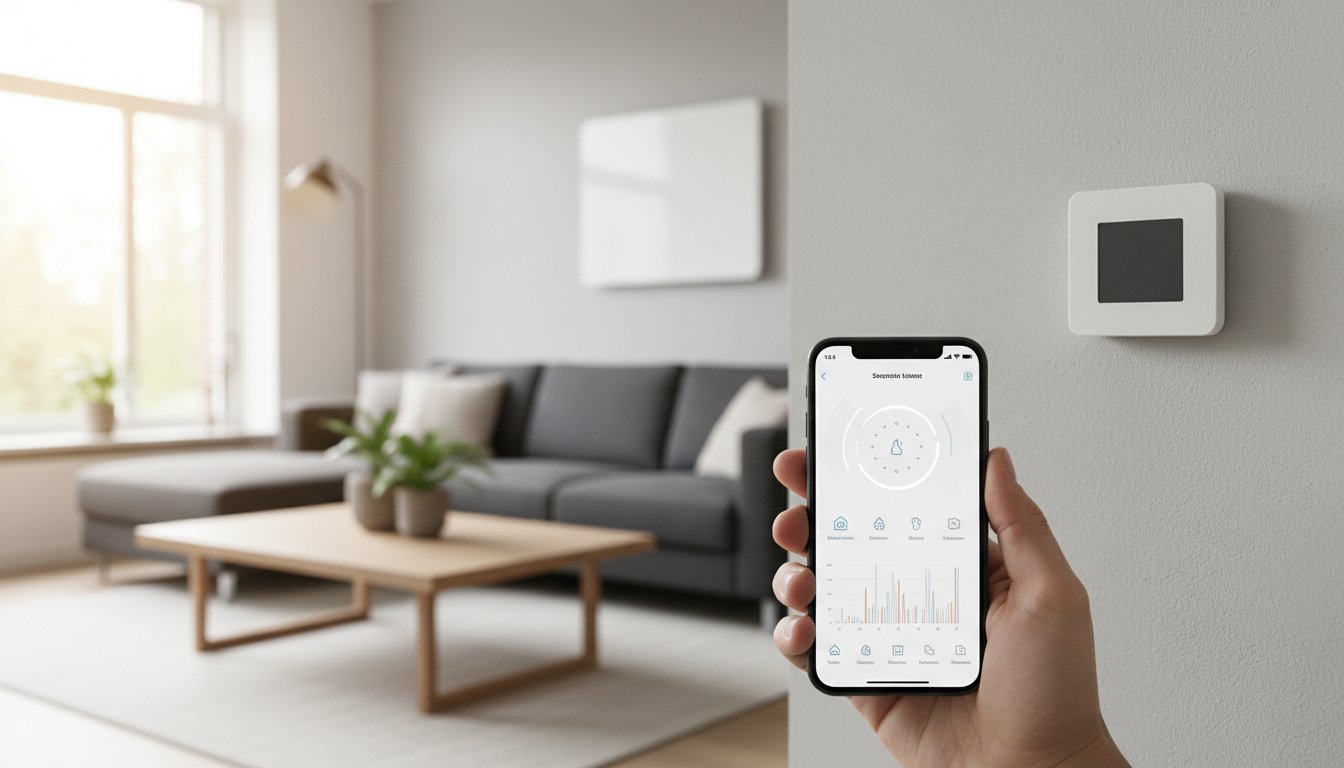
Wireless controls can avoid a signal cable between sensor and receiver. Panels and switching equipment still need power. Check existing controls and manufacturer-approved combinations first; wireless is not a universal replacement for every boiler or electric thermostat.
Key considerations
Record panel, thermostat and receiver models, total load and required functions. Assess communication, sensors, power and mounting together. Frequency, brand or a Wi-Fi logo alone cannot establish compatibility.
What does a wireless system do?
In some systems a separate thermostat measures temperature and a receiver controls heating. Thermostats may use batteries or fixed power. RF may provide local communication; Wi-Fi may be in the thermostat, receiver or separate gateway. Not every system needs an app, internet or account. Check exact required components and services.
Communication and measurement
Walls, concrete, metal, distance and interference affect range. Generic distances or frequencies cannot guarantee a connection. Test the intended location. Accuracy, hysteresis and learning control are different properties. Consumption indications are not automatically actual metering. Check behaviour after signal loss, empty batteries or power failure; do not assume safe shutdown or guaranteed frost protection.
Select by functions and load
Have switching output, load type, operating duration and total connection assessed from exact data. There is no universal 16 A receiver rule. Boiler thermostats are not automatically suitable to switch panel loads. Floor heating also needs compatible sensors and temperature limits for the system and finish. Have bathroom position, protection and connection assessed together. Choose simple or smart controls as needed; cloud operation is not indispensable.
Prepare and check installation
Have fixed wiring and changes performed by a qualified installer following product diagrams. Do not conceal receivers behind panels or in boxes without model approval. Follow space, cooling and cable instructions. Position sensors representatively, considering sun, draughts and heat sources; no fixed height applies everywhere. Pair as instructed and test demand, shutdown and fault behaviour.
Zones and daily use
Check the actual receiver and zone count supported. Motion sensors can miss seated users. Match programmes to occupancy and explain temporary changes to others. Assess interaction with existing heating. Programming promises no fixed saving or higher conversion efficiency; heat loss, settings and actual operating time remain decisive.
Advice and maintenance
Send model numbers, manuals, panel count, outputs, layout and control preferences. We help private and business end users, installers and wholesalers with selection and quotations. Check operation and warnings regularly. Use specified batteries only and replace as instructed; no universal life or warning interval applies. Low maintenance is not maintenance-free.
Frequently asked questions
Google Home, Alexa, geofencing and multiple zones require explicit support by the complete combination. Receivers on the same frequency are not automatically interchangeable. Do not reset or bypass electrical parts to evade faults. Follow troubleshooting instructions and have recurring problems assessed. Wireless communication does not remove all fitting work or risks; have the full layout checked.