
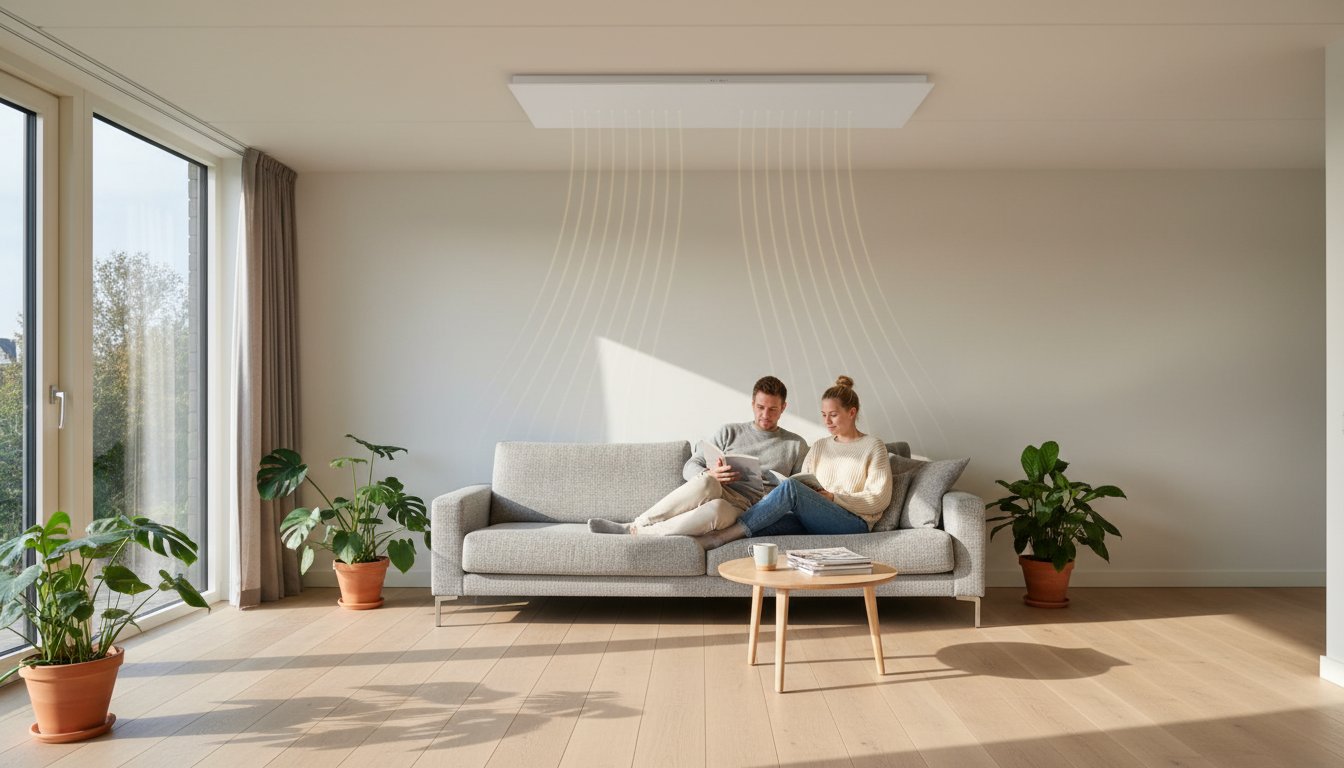
Start with where heat is needed and the mounting permitted for the exact appliance. An attractive empty wall is not enough: distances, obstacles, supports, electrical connection and controls must fit together. There is no universally best position.
Key considerations
Map seating, workstations, furniture, windows, doors and walkways. Check the manual before choosing wall or ceiling mounting. Consider hot surfaces and accessibility to children and pets.
How placement affects heat
Panels emit radiation and convection. Direction, distance and obstructions affect which people and surfaces receive radiation. Tables, sofas or curtains can block its direct path without stopping all other heat transfer. There is no universal radiation angle or range limit. Glass behaviour depends on wavelength and construction; a blanket ban on facing every window cannot replace heat-loss and layout assessment.
Compare wall and ceiling positions
Ceiling mounting may free wall space; wall mounting can direct heat towards an occupied zone. Both need approved models and fixings. Ceiling panels do not automatically radiate in every direction or avoid obstacles, nor guarantee warm floors. Wall height and distance to seating vary. Have supports, ceiling construction and temperature-sensitive materials assessed.
Position by room use
Living rooms require consideration of sofas, tables and users. Kitchens also involve extraction, grease, moisture and cooking appliances; do not simply install over a hob. Bathrooms need assessment of model, zone and installation; mirrors do not always prevent condensation. In bedrooms consider beds and hot surfaces without a universal head- or foot-end position. Ordinary wall panels are not automatically permitted under desks.
Avoid common mistakes
Do not conceal heaters behind furniture or fabrics or cover them. Generic centimetre clearances, angles or heights are not safety rules. More output cannot fix prohibited mounting or unsuitable supports. Move or tilt only within instructions. Overheat protection does not authorise ignoring clearances.
Installation, sensor and controls
Have supply, circuit load, connection and protection assessed. Use specified mountings and clearances. Choose demonstrably compatible thermostats and receivers. Place sensors as instructed in representative locations, considering sun, draughts and other heat sources. Wi-Fi or zoning is not standard. Test from occupied spots and after furniture changes.
Help with a layout plan
Send plans, photos of positions and insulation, use and existing-heating details. We advise private and business end users, installers and wholesalers on selection and quotations. Output follows demand and layout. Good placement promises no fixed savings, health gains or elimination of downdraughts. Follow cleaning and inspection instructions too.
Frequently asked questions
There is no ideal wall height, head distance or clearance for all panels. Check exact instructions and seek assessment if unsure. Suitability near a corner or facing a window depends on the appliance and actual layout. Nearby furniture may block radiation and cause heat accumulation; prevent this instead of relying on protection. Low maintenance is not maintenance-free, and installation must remain suitable after layout changes.