
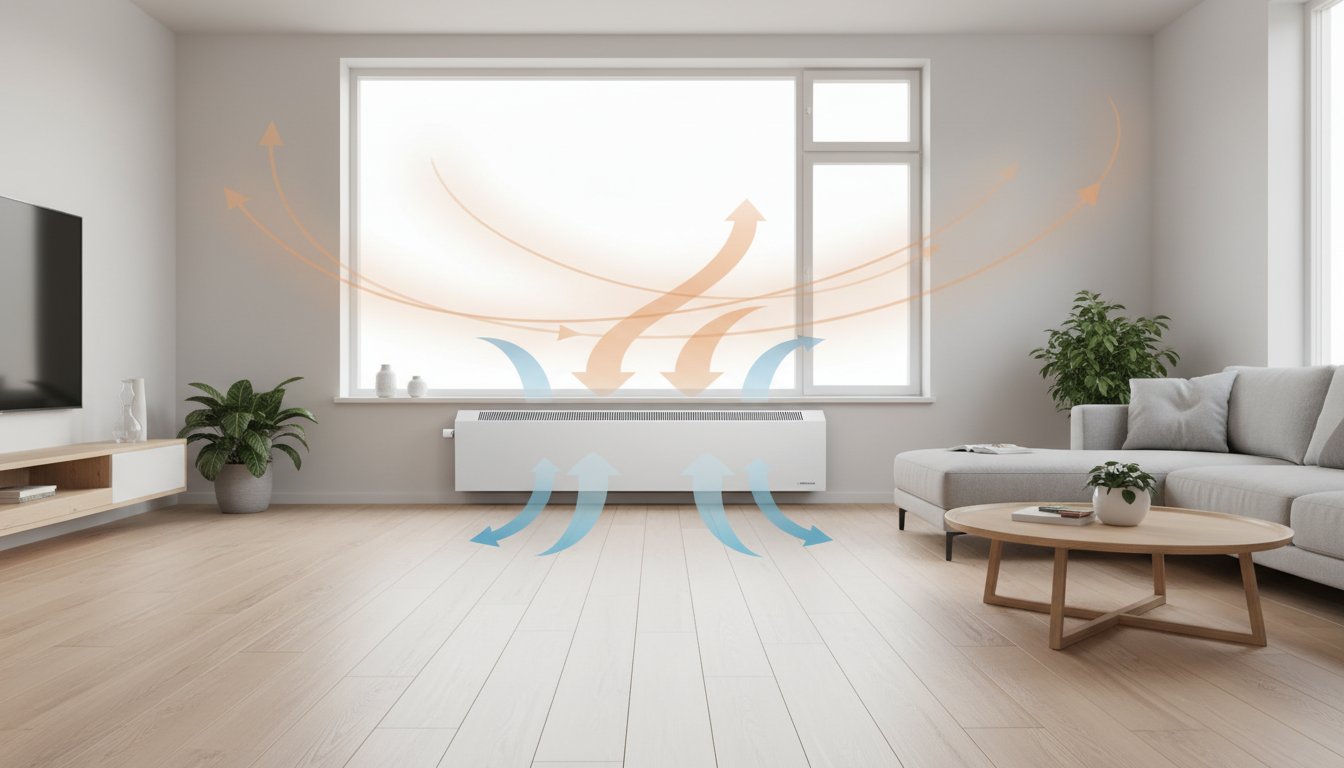
Buying convectors starts with distinguishing electric appliances from water-fed convectors. Both mainly transfer heat to passing air, but connections and controls differ. First consider the existing installation, intended heating task and room.
Key points
Compare complete systems rather than wattages alone. For a water-fed convector, output at the actual supply temperature matters. For an electric convector, power and operating time determine consumption. Mounting, sound and safety remain model-specific.
How a convector delivers heat
A warm element or heat exchanger heats passing air. Some appliances use natural convection, others a fan. Construction, heat source and controls determine response. No fixed warm-up time or precise radiant fraction applies to every model. Radiators and infrared panels can also combine heat-transfer mechanisms.
Wall model, portable appliance or trench convector
Wall-mounted and portable appliances each have placement requirements. Check unobstructed air inlets and outlets and distances from furniture and curtains. Trench convectors also require assessment of the floor structure, access and cleaning. With a heat pump, water-fed output must suit the chosen system temperatures; the label “low temperature” alone is insufficient.
Compare comfort and costs with infrared
A convector mainly heats air; infrared may add targeted radiant comfort but also produces convection. Neither makes the room dust-free or replaces ventilation. Compare the same heat demand and usage period. Electric resistance appliances ultimately convert electricity almost entirely into heat; this does not prove lower consumption for one type. Include existing heating, purchase, mounting, controls and maintenance.
Buying criteria and safety
Have heat demand assessed rather than relying only on a fixed watts-per-cubic-metre rule. Compare current functions such as scheduling, Wi-Fi or window detection for the actual model; they are not universal and do not establish fixed savings. Check electrical load and mounting. For bathrooms, application, position, IP protection and connection must be assessed together. A fixed 60-centimetre distance is not a complete installation rule for all appliances.
Discussing product selection with us
We advise private and business end users and work with installers and wholesalers. Share room data, the existing installation and intended use. We discuss suitable products and missing information. Agree who calculates, mounts and connects and request the selected version’s warranty conditions.
Choose for the complete application
A low purchase price, European origin or smart controls do not predict the lowest lifetime costs. Compare a complete proposal for the same comfort and tariffs. After commissioning, check temperature, sound and controls and adjust settings where necessary.
View electric convectors · Request advice and a quotation
Frequently asked questions
Is a fanless appliance completely silent? Not necessarily. Relays, expansion or other components may be audible. Compare actual model data and measurement conditions. A general decibel figure does not apply to all fan-assisted models.
Can I vacuum inside it myself? Follow the cleaning instructions. Switch off, allow cooling and do not open the appliance unless the manual permits it. A fixed cleaning frequency or vacuuming method is not suitable for every product.