
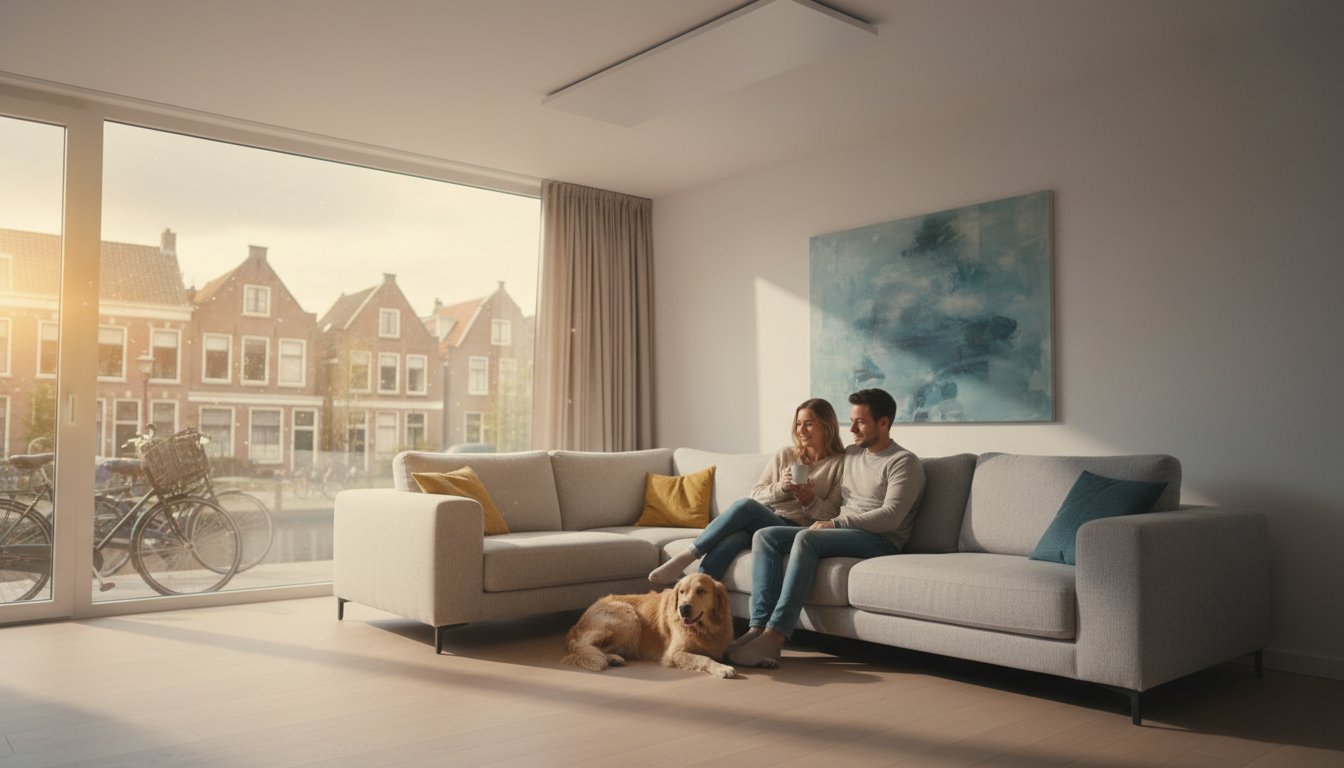
Do you have questions about the fire risk of infrared panels? Then it is important to consider both the specific product and its installation. An infrared panel is an electric heating appliance that can become hot. No type of heating is without risk under all circumstances.
We help you choose a version and collect the right product information. The manual determines the permitted mounting, clearances, connection and use. A thermostat, safety device or certificate is no substitute for following those conditions.
Key points
- Hot surfaces can cause burns; prevent contact, especially for children and other vulnerable users.
- Do not cover the panel and keep the clearance specified by the manufacturer unobstructed.
- Assess the mounting surface, fixings and electrical connection for the specific model.
- Stop using the system if it is damaged or you suspect a fault, and have it checked.
- Base safety decisions on the manual and an installation assessment, rather than a general temperature or certification claim.
Which risks should you assess?
Surface temperature, heat build-up, damage and the electrical installation are among the factors that matter for infrared heating. The risks depend on the version and circumstances. We therefore do not state a general fire risk or guarantee that a panel can never cause a fire.
Comparing the panel temperature with a stated ignition point of wood does not prove that mounting on a particular surface is safe. The manufacturer’s conditions and the actual arrangement remain the determining factors. The back of a panel can also become warm.
Hot surfaces and accessibility
A surface can be hot enough to cause injury when touched. An even temperature or low thermal mass does not automatically prevent this. Choose the mounting location so that the specified use remains possible and prevent unintended contact. Take furniture, playing children and changes to the room layout into account.
Ceiling mounting can help position a suitable product out of reach. This does not remove the need for correct fixings and the specified clearances. The conditions for the specific model also apply to wall mounting.
Safety devices and controls
The product documentation states which safety devices are present and how they work. We do not assume a fixed number of sensors, a universal shutdown temperature or a guaranteed response within a certain time.
A safety device can reduce risks, but must not be deliberately tested by covering the panel or using it incorrectly. Bypassing a safety device, modifying it yourself or repeatedly switching it back on after a fault is not a solution. Follow the instructions and have the cause assessed.
A thermostat has a different function
A room thermostat controls the heating based on the measured temperature and settings. This does not mean that every thermostat monitors all parts of the panel. A set room temperature does not guarantee that surfaces are cool or that the arrangement is suitable.
Have the compatibility of the panel, thermostat and any receiver assessed. The permitted load and connection differ by version.
Comparing heating systems
Infrared panels, convectors and portable heaters come in different versions with different conditions of use. The name of the technology or the price alone does not determine which arrangement is appropriate. Compare the characteristics of specific products for the same application.
The absence of a fan or liquid circuit does not mean that an appliance cannot develop a fault. Electrical components, connections, fixings and controls must also be checked in accordance with the manual in a low-maintenance system.
High conversion efficiency is not a fire safety certification. The electrical installation must be matched to the actual load. Calculating the required heating output does not replace that assessment.
Mounting, connection and use
Clearance and mounting surface
Check whether the model is approved for wall, ceiling or another type of mounting. Follow the specified distances from people, furniture, curtains and building materials. There is no universal clearance that applies to all infrared panels.
Do not cover the panel with clothing, towels or other objects. Do not use it as a drying rack unless a specific version and accompanying accessory are expressly intended for this purpose. Also keep the specified clearance at the back unobstructed.
The fixings and mounting surface must be suitable for the weight and permitted mounting of the product. A wooden ceiling, plasterboard or suspended ceiling is not suitable solely because of an assumed low rear temperature. Have load-bearing capacity and fasteners assessed.
Electrical connection
Have a competent installer assess the connection, circuit load, wiring and protective devices. Also follow the instructions for cables, plugs and any receivers. An existing socket or junction box is not automatically suitable for every arrangement.
Do not use damaged cables or plugs. Prevent cables from being pinched and do not place them in a hot location. Connect a plug-in version to a suitable fixed socket in accordance with the manual. Do not daisy-chain power strips. Have the connection point and cabling assessed if there is any doubt.
Damp rooms
For a bathroom, assess the mounting location, the model’s permitted application and the electrical installation together. An IP rating alone does not give general permission for installation in a zone or near a shower. Have the installer assess the combination.
In the event of damage or unusual behaviour
Stop use in the event of damage, scorch marks, an unusual burning smell or a suspected electrical fault. Switch the appliance off using its intended controls if it is safe to do so. Do not touch damaged or hot parts and have the system checked by a competent installer before using it again.
Do not open the housing to repair wiring or thermal safety devices yourself. In the event of smoke or fire: get yourself and others to safety and call the emergency services. Do not first try to examine an unsafe appliance or switch it back on.
Product information and advice
Ask for the manual, technical data and applicable conformity documentation for the chosen version. Check whether a stated certificate relates to that exact product and version. Certification is not a guarantee against all risks and does not automatically permit every use.
We do not make a general statement that all our panels have the same sensors, insulation, certifications or warranty period. These details differ by model. Warranty conditions likewise do not give permission to deviate from mounting or operating instructions.
We support private and business end users, installation companies and other business partners in choosing a suitable product. Send us details of the room, the intended mounting location and the desired use so that we can discuss the relevant documentation.
Discuss your heating project
A suitable proposal describes the selected products, controls and assumptions for mounting and connection. Make clear who assesses, carries out and commissions the installation.
Request a quote or contact us if you have questions about the product conditions. Browse our range for the available versions.
Frequently asked questions about safety
Can an infrared panel cause a fire?
An electric heating appliance is not without risk under all circumstances. Choose a suitable product, follow the manual and have the installation assessed. We do not guarantee that a safety device will prevent every incident.
Can a panel be fitted to a wooden ceiling?
Only if the version, mounting surface and fixings concerned are suitable according to the product conditions and installation assessment. Do not rely on a general rear temperature or a stated ignition point of wood.
What if the panel is covered?
Do not cover it. Do not rely on the assumption that a safety device will always switch it off in time. If overheating or damage is suspected, stop use and have the appliance checked.
Is an infrared panel safe in a child’s bedroom?
Assess the specific product and prevent access to and contact with hot surfaces. Ceiling mounting does not eliminate all risks. Follow the manufacturer’s conditions and take vulnerable users into account.
How hot does the back become?
This differs by model and operating conditions. Use only the information for the version concerned. A general temperature is not a basis for omitting specified clearances or protection.
Do I need to change my insurance?
Check the conditions of your own insurance and discuss the installation with your insurer if necessary. We cannot promise general coverage or acceptance for all homes and commercial premises.