
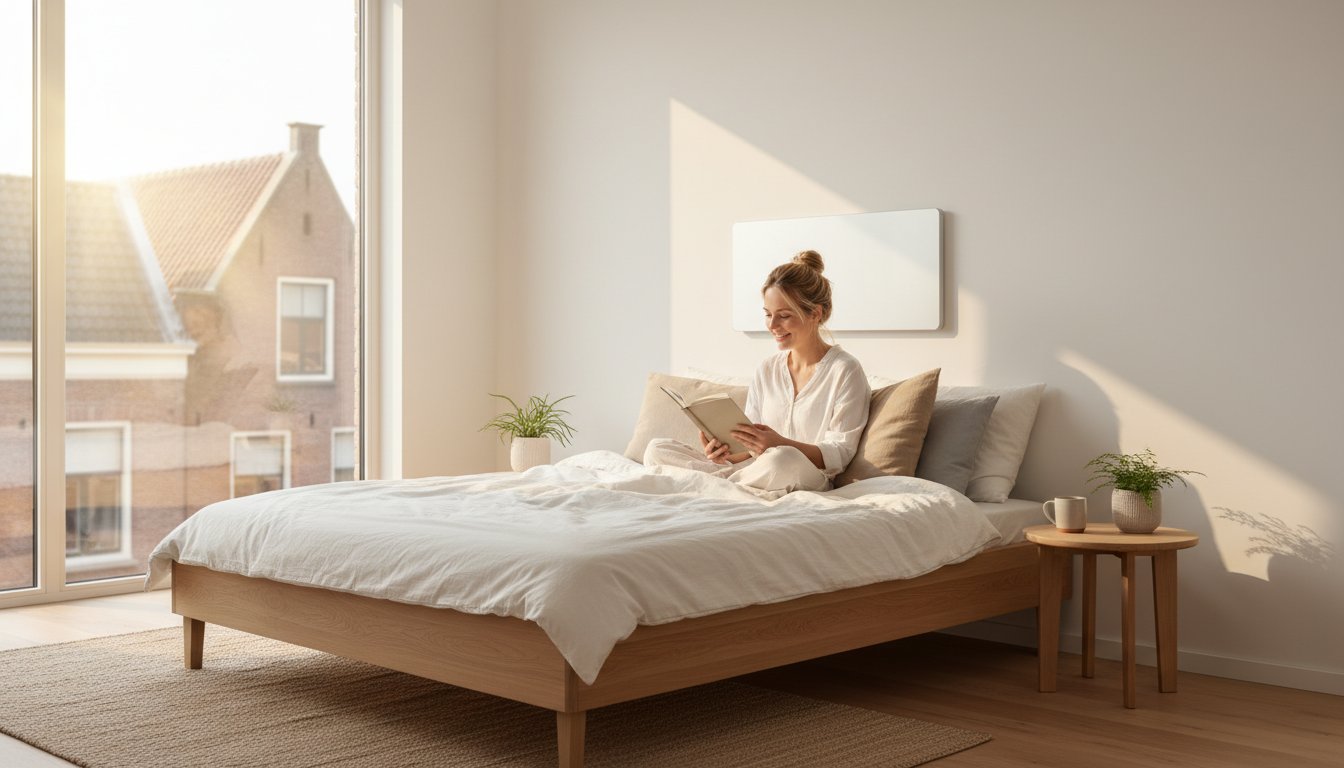
Supplementary heating in the bedroom may be intended for dressing, a reading corner or supporting room temperature. First decide when and where you want heat. That is a different question from unattended use throughout the night. The chosen appliance and mounting must suit the intended situation.
This guide helps assess comfort, controls and the presence of bedding and curtains together. We discuss options with private and business end users and support installation companies and wholesalers. A bedroom needs a suitable design without general promises about health or better sleep.
Key points
Explicitly choose primary or supplementary heating and check use while sleeping separately in the manual. Maintain all product clearances and prevent contact or covering by textiles. Position the sensor representatively and test programmes. A thermostat or overheating protection does not automatically make every appliance suitable for overnight use.
Determining the actual comfort requirement
Note when the room is used and whether the existing heating performs adequately then. Sometimes improving settings or repairing the existing controls helps. Not every bedroom needs additional heating. Nor is there one universal temperature setting for every occupant, age and situation; choose appropriate comfort and consult the responsible healthcare professional for specific care questions.
Distinguish warmth while dressing from bringing an entire room to temperature. A local radiant source may be noticeable while other areas remain cool. Consider different occupants and the rest of the home. A low main thermostat setting such as fifteen degrees is not general advice for every combination.
What infrared can do in the bedroom
A panel delivers radiant heat to people and surfaces it can reach and also heats air by convection. Ordinary radiators emit radiant heat too. Position, distance and shielding determine the local sensation of warmth. Directly heating the bed by radiation is not automatically the right solution; assess comfort and the use and mounting instructions for the specific version and users.
Heat in walls and furniture can be released later, but heat loss through the façade, glazing and ventilation remains. There is no guaranteed fixed reduction in air temperature or energy use. With supplementary heating, add panel consumption to what the existing installation still uses; only the total provides a fair comparison.
Indoor air and moisture
Having no fan does not mean having no dust or natural air movement. Heating may change relative humidity and does not replace ventilation. A panel does not treat allergies, asthma, a dry throat or burning eyes. Investigate the causes of complaints and moisture problems rather than expecting a different heating surface to resolve them.
Comparing infrared and convectors
Compare warm-up time, heat distribution, noise, operation and suitable mounting for the same comfort requirement. Both resistance appliances generate heat from electricity. A five-hundred-watt panel is not generally equivalent to a fifteen-hundred-watt convector. An assumed longer life or lower ten-year costs requires data for the specific products.
A panel without a fan may produce noise from relays, electronics or thermal expansion. Check indicators and operation if the room is used for sleeping. Textiles around the bed and window require attention with every heating appliance; no open flame does not mean no fire or contact risk. Compare model clearances and permitted operating duration.
Preparing capacity and positioning
For room heating, use an appropriate heat-loss calculation including dimensions, insulation, glazing, external surfaces, ventilation and the desired temperature. Volume or floor area alone is insufficient. A fifteen-square-metre bedroom does not automatically have one fixed wattage choice. For local warmth, also assess where and for how long the user sits or stands.
Choose wall or ceiling mounting only if the manufacturer permits it for the version. Maintain the prescribed clearances from the bed, curtains, furniture and other materials. Universal twenty-centimetre rules, eye level or a fixed radiation angle are not a safe substitute for model information. Also assess load-bearing capacity, cable routing and maintenance access.
Have fixed electrical work carried out competently and check simultaneous load. A suitable plug-in unit also needs a suitable connection and location. Avoid cables where people step out of bed or furniture can damage them. A temporary heater is not automatically suitable as a permanent solution beside the bed.
Choosing a version and controls with us
Send photos or a floor plan, dimensions, existing heating and usage times. Mention children, pets or other vulnerable users where relevant to positioning. We discuss product options with you and, where appropriate, the installation company or wholesaler. Mirror, colour and image are model options and must be confirmed before ordering.
A suitable thermostat with a representative sensor can manage a schedule for the times of use. Wi-Fi is not essential, and an app does not always measure electricity. Also test manual operation, recovery after power failure and whether a temporary override automatically expires later according to the settings. Include only functions available and understandable for the chosen product.
A comfortable, manageable bedroom plan
Request a proposal identifying application, mounting, controls and operating limits. Include maintenance, warranty and possible component replacement. An expected long life or product origin does not prove guaranteed sleep quality or a lower bill. Assess the initial period with the occupants and make adjustments only within the manual’s instructions.
Frequently asked questions
Can the panel stay on all night?
Only when the exact version and complete installation are intended for that operating duration and those conditions and all instructions are followed. A thermostat alone is not proof of this. Check the manual and have doubts assessed, especially with limited mobility or vulnerable users. Do not use a portable appliance unattended unless the manufacturer explicitly permits it.
How do I calculate costs?
An appliance actually drawing 0.5 kilowatts for four operating hours consumes 2 kilowatt-hours. This is only a calculation example, not a prediction for a night or bedroom. Use your own tariff and actual hours, and include the remaining main heating. Then compare the same comfort without assuming in advance that supplementary heating is always cheaper.