
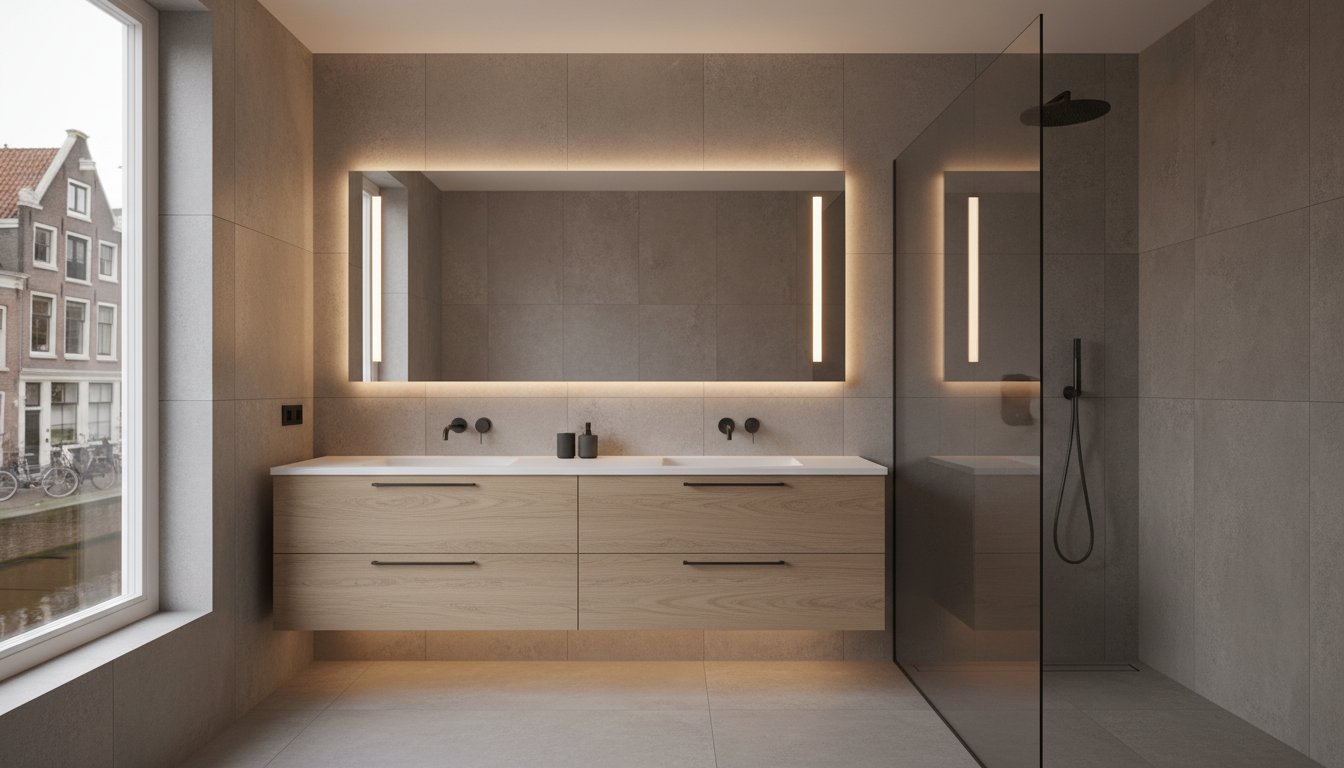
Heating a bathroom with infrared starts with the comfort you want and where the appliance can be positioned safely. Heat demand, operating duration and electrical installation determine the suitable combination. A heating panel, mirror demister and electric underfloor heating have different functions; choose them according to the specific room.
Key considerations
We supply private and business end users, installation companies and wholesalers. With dimensions, insulation information and a layout, we can prepare a proposal. This guide helps you choose but does not replace assessment of the electrical installation or a product manual.
Determining comfort and use first
An infrared panel emits heat through radiation and convection. The air warms up too. Water-based radiators also emit both forms of heat; the proportions vary with appliance and temperature. There is no general warm-up time or fixed saving applicable to every bathroom.
A panel needs time to reach operating temperature. Warm-up time and the perceptible effect depend on model, distance, surface temperatures and the space. Higher air temperature is not the only factor in comfort, but no fixed thermostat reduction guarantees the same comfort for everyone.
Assessing mounting position and capacity
Have a competent installer determine the zone from the actual layout and current regulations in the Netherlands or Belgium. The assessment includes the model, connection, earthing where applicable, protection, wiring and controls. This guide gives no general permission for installation above the shower, in zone 1 or within a fixed distance of a water source.
An IP rating describes a particular level of enclosure protection. Even a high IP rating does not prove the complete appliance may be mounted in every shower location. Permitted orientation, use, connection and clearances remain relevant. Do not choose an appliance solely by the words splashproof or water-resistant.
Determine required capacity from heat loss, desired temperature, ventilation and operating duration. A fixed value per square or cubic metre without these data is not a final design. Distinguish heating output in watts, the local radiant effect and electricity consumption in kWh.
Choosing versions and functions
A heated mirror can combine a mirror and heat source. Check whether the product is intended for room heating or only mirror demisting; these are different functions. Output, exact dimensions, connection and any lighting or controls vary by version. Compare output and size together so the selected version fits the available position with all prescribed clearances.
A wall or ceiling panel must be able to radiate towards the desired occupied zone without obstruction by tall cupboards or other objects. Not every wall model may be ceiling-mounted. A panel must not be covered with towels either, unless the manufacturer has supplied a feature explicitly approved for that purpose.
For a panel with LED lighting, check lighting and heating separately: light colour, dimming options, controls and connection vary by model. An app or smart-home connection is not included as standard. Ask about the complete set, including any receiver and gateway needed.
Assessing consumption and indoor climate realistically
Compare purchase, installation, controls and running costs for the same heat demand. Direct electric resistance heating and a heat pump are technically different systems: a heat pump moves environmental heat. Solar panels can supply electricity, but generation and heat demand do not always coincide. Electric heating is therefore not automatically free or emission-free.
Heating does not replace ventilation. Warmer surfaces can reduce condensation, but a panel does not remove water vapour or resolve leaks or building-related moisture problems. Assess mould, condensation and ventilation separately. An infrared panel is not a medical treatment.
How much electricity does a panel use?
A 600-watt panel operating continuously at full power for one hour uses approximately 0.6 kWh. Multiply actual consumption by your total electricity tariff. This is a calculation example, not a prediction of daily operating time.
Coordinating installation, controls and proposal
Check substrate, load-bearing capacity, fixings and clearances according to the manual. Ceiling mounting is not always the best choice. Have a competent installer assess supply, protection and combined electrical load. An existing plug or wireless thermostat does not make every connection or location suitable.
Plan a suitable thermostat and sensor position. Not every panel has a built-in thermostat, and not every separate controller suits every appliance. Check the complete combination, switching capacity and control behaviour in the bathroom. A timer or open-window function does not replace correct sizing.
We supply private and business end users and installation companies and wholesalers. Share dimensions, photos or a floor plan, insulation and usage times. Mention existing heating and wishes for mounting and operation. We discuss suitable combinations for your own building or customer project and identify which technical information is still needed.
Check the complete solution
Ask about warranty and cleaning instructions for the specific product. Scratch resistance, colourfastness and service life cannot be promised equally for every surface. A measurement standard or environmental registration is not a general guarantee of savings. Also compare installation, controls and running costs at the same comfort level.
Frequently asked questions about infrared in the bathroom
Can the outside become hot?
Yes. Surface temperatures differ by version and can present a contact risk. Choose an approved mounting position with children, pets and other vulnerable users in mind. A temperature limiter does not automatically make touching safe. Do not cover the appliance unless explicitly permitted.
Can I combine a panel with electric underfloor heating?
A combination may be possible, but coordinate capacity, controls and sensors. Otherwise systems may heat simultaneously unnecessarily. Check floor construction, permitted floor temperature and the underfloor heating product instructions separately. An additional panel does not replace that assessment.