
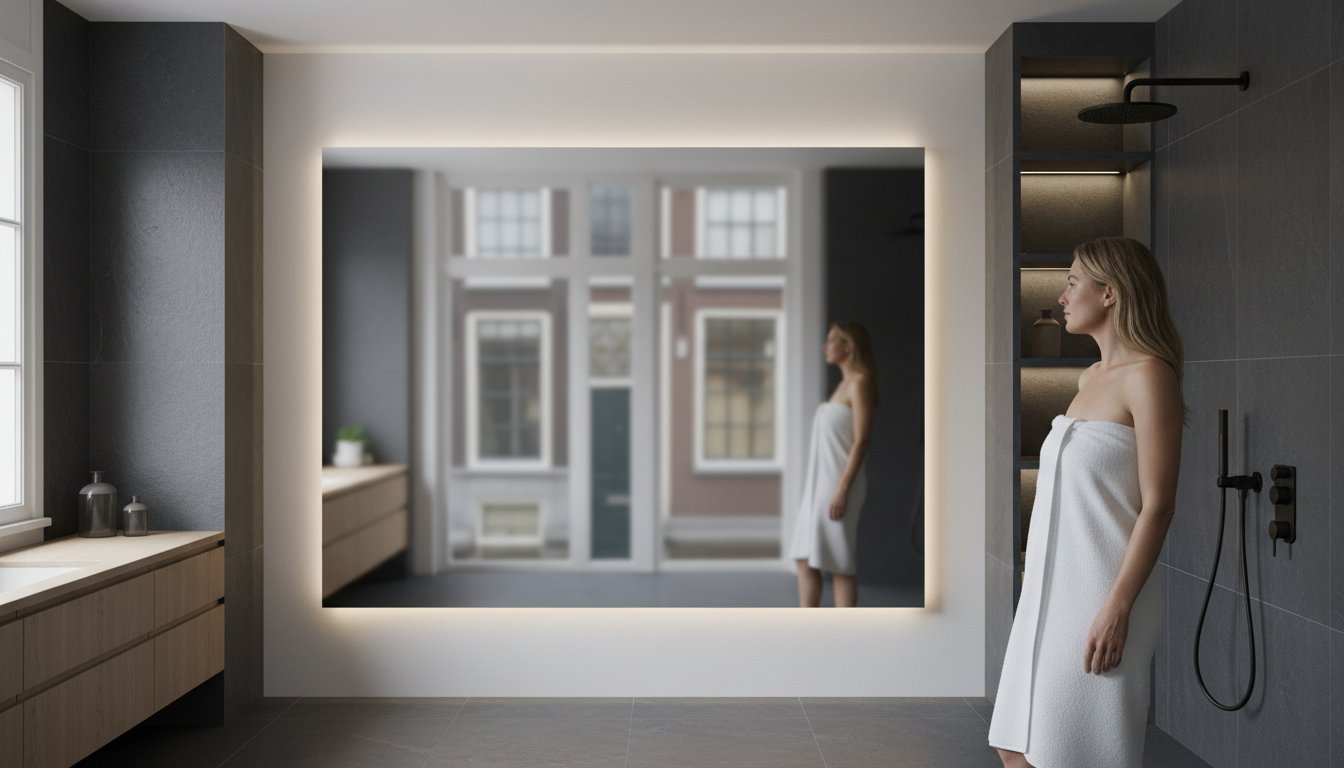
Infrared bathroom heating requires comfort, positioning and electrical safety to work together. A compact panel can be interesting for renovation or supplementary heat but does not automatically fit every free wall or ceiling. This guide helps assess application, version and controls step by step.
Key points
Start with a plan, usage times and heat demand. Then check manufacturer approval for the exact mounting position. IP is only one property. Layout, electrical protection, surface temperature and clearances matter too.
When might infrared suit a bathroom?
Panels may provide targeted heat or form part of whole-room heating. They radiate towards people and surfaces and also emit convective heat. Response and sensation vary by model, mounting and initial temperature. Do not assume immediate warmth or disappearing draughts and cold surfaces.
Heating and moisture are separate concerns
Warmer surfaces can limit condensation but panels do not remove shower moisture. Ventilation, cleaning and leak repair remain necessary. There is no general guarantee against mould, dust mites, allergies or asthma. A radiator alone is not the cause of damp either; assess the whole indoor climate.
Assess product data and safe positioning
IP describes protection against solid particles and water under its classification. It does not determine whether a heater may be fitted at a particular shower location. Have an installer assess current rules, geometry, manual, connection and protection together. Dutch and Belgian rules are not automatically interchangeable.
Check input, weight, fixings, permitted orientation, surface temperature and controls. Consider access by children and vulnerable users. Temperature sensors or overheating protection do not make touching safe. Do not cover with towels unless expressly permitted.
The right output requires calculation
Use losses, dimensions, insulation, external surfaces, ventilation and temperature as the basis. Fixed 60–100 watts per cubic metre is no universal bathroom standard. Primary heating needs enough output at design conditions. Blind oversizing may unnecessarily burden connection, positioning and controls.
Which version suits your bathroom?
Metal, glass and mirror panels vary in dimensions, weight, appearance and mounting. LED, RAL colours, printing and towel rails are not available on all products. Choose finishes after technical suitability. Material alone establishes neither efficiency nor lifespan.
Mirror heating is not always room heating
Small mirror heaters may only reduce condensation on part of the glass. Mirror infrared room panels have another role and need sizing for demand. Neither guarantees full clarity in every condition. Check independent lighting and heating control too.
Coordinate positioning and controls
Assess coverage from the occupied spot. Cabinets, shower screens and obstacles may screen radiation. Ceiling mounting frees walls but is not always best or a replacement for underfloor heating. Follow clearances and preserve maintenance and electrical access.
Choose compatible controls and sensor position. Schedule warm-up for morning and evening routines. Presence, Wi-Fi and metering require supported versions. Coordinate multiple sources to avoid unnecessary simultaneous heating.
A proposal for your room or customer project
We help private and business users choose and obtain products. Installers and wholesalers can approach us for customer projects and cooperation. Send dimensions, photos or plan, insulation, temperatures and hours. Mention existing heating and electrical connections.
Check comfort, costs and maintenance
Compare equal comfort and calculate actual hours with your total tariff. As an illustrative example, a device drawing 600 watts continuously for an hour uses 0.6 kWh. Multiply actual kWh by your tariff; it predicts neither daily time nor savings. Solar or environmental-database listings do not make use automatically carbon-neutral. Follow exact maintenance and warranty conditions.
Frequently asked questions
Can a panel replace the existing radiator?
This needs loss calculation and assessment of position, output and electrical capacity. Old radiator size or rating alone is insufficient selection evidence. Compare costs and alternatives too.
Is a small bathroom easier?
Small bathrooms may have few permitted positions. Consider water points, reach risks, doors and clearances. Have layout assessed before buying.