
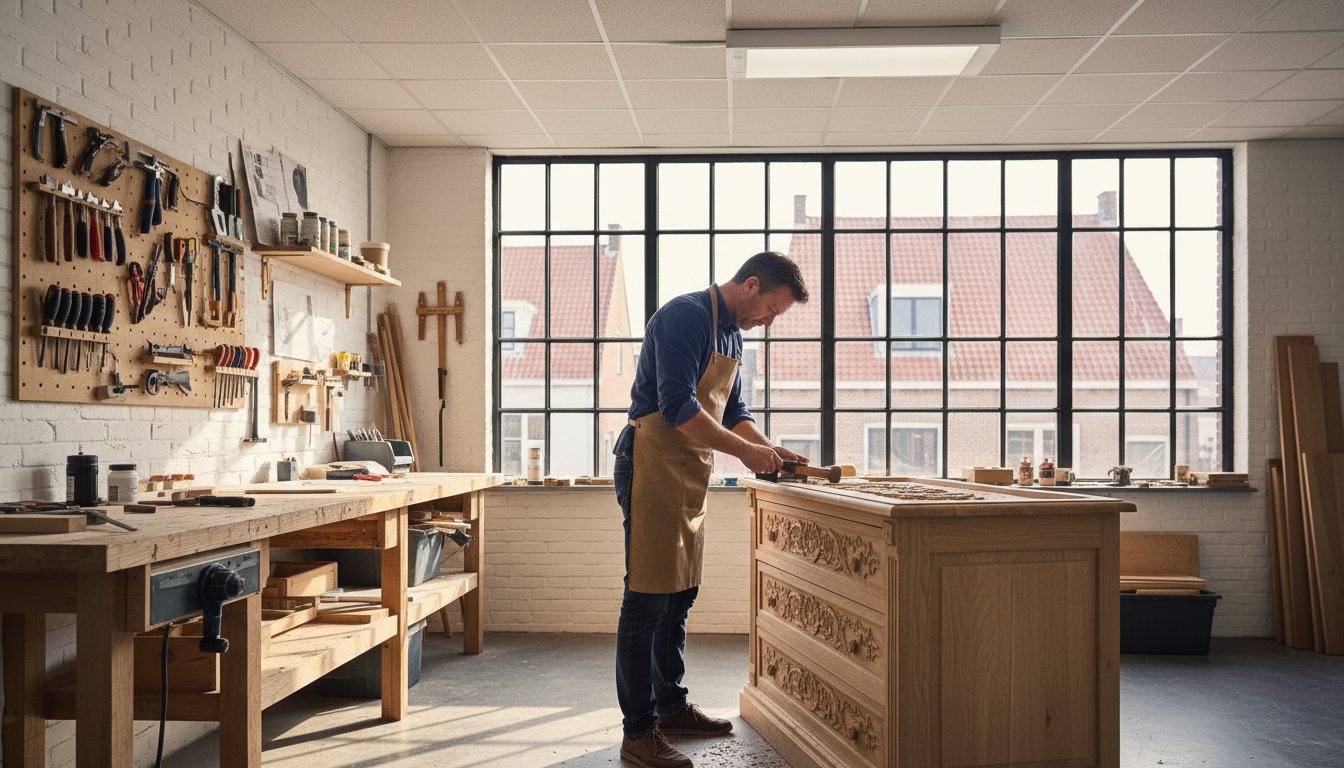
A temperature-stable studio needs more than an accurate thermostat. Insulation, ventilation, doors, use and stored materials together determine the required climate. Infrared heating can form part of the heating plan, but does not automatically guarantee a fixed temperature tolerance or artwork protection.
Key considerations
First establish whether you need working comfort, material storage, frost protection or controlled production conditions. These are different tasks. Specify temperature, humidity and permitted fluctuations for the materials and process; there is no universal studio setting.
Specify climate needs for people and materials
Wood, paint, paper and other materials respond differently to heat and relative humidity. For vulnerable artworks or storage, consult a conservator or material supplier. Do not aim a heater at paintings to accelerate drying without an approved, justified process. A general 1.5-metre distance does not guarantee safe drying or preservation.
Heating does not replace ventilation. Warmer surfaces may reduce condensation, but a panel does not remove water vapour or repair leaks or building moisture problems. Assess mould, condensation and ventilation separately. An infrared panel is not a medical treatment.
Understand heat storage and controls
A warm device can radiate towards people and surfaces and heat air through convection. The proportion varies by version. Conventional radiators also radiate heat. An infrared radiator therefore does not eliminate air movement, and a flat panel is not automatically technically identical to every other device with that name.
Walls, floors and contents can absorb and release heat, but amounts and rates vary. An open door still causes heat loss. There is no fixed recovery time for every studio and thermal mass does not replace capacity or controls. Measure temperature and relative humidity at relevant locations during normal use.
Compare systems against the same climate requirements
With electric resistance heating, almost all input electricity ultimately becomes heat. This differs from radiant share or running costs. A heat pump can move environmental heat and should be assessed as a different technology. At equal heat demand and comfort, compare installation, controls, maintenance and energy too.
Radiant heat can contribute to comfort but does not guarantee dust-free air, moisture balance or treatment of allergies and asthma. Ventilation and cleaning remain necessary. Warmer surfaces can limit condensation; persistent damp also requires investigating its cause. Fixed savings or lower thermostat settings cannot be promised for every room.
Compare purchase, installation, controls and running costs for the same heat demand. Direct electric resistance heating and a heat pump are technically different systems: a heat pump moves ambient heat. Solar panels can supply electricity, but production and heat demand do not always coincide. Electric heating is therefore not automatically free or emission-free.
Plan capacity, sensors and safety
Include heat loss, insulation, windows, external surfaces, ventilation and target temperature. A fixed wattage per square or cubic metre is not a complete calculation. More power does not automatically mean less consumption. Device count follows required output and possible locations, not a standard two or three radiators per living room.
Check substrate, load capacity, fixings and clearances according to the manual. Ceiling installation is not always best. Have a competent installer assess supply, protection and combined electrical load. A plug or wireless thermostat does not make every connection or location suitable.
Choose compatible controls, receiver and sensor location. Wi-Fi, window detection or energy monitoring vary by combination. Follow manual cleaning and inspection requirements and keep connections accessible where needed. Low-maintenance does not exclude faults, wear or replacement parts.
Place sensors according to controller instructions and verify representative readings. Direct radiation, sun, draughts and equipment can affect measurements. An app or thermostat accuracy specification does not prove the whole studio stays within 0.3 or 0.5 degrees continuously. For critical storage, discuss monitoring and response to failure.
Paints, solvents, varnishes or combustible dust require a separate fire and explosion risk assessment. Hot surfaces and electrical sparks can be ignition sources. A standard panel or IP rating does not approve use in an explosive atmosphere. Have suitability and installation assessed beforehand.
A proposal for your studio
We supply private and business end users, installers and wholesalers. Share dimensions, photos or a plan, insulation and usage times. Include existing heating and mounting and operation preferences. We discuss suitable combinations for your building or customer project and identify technical information still needed.
Check results during use
Ask for the specific product’s warranty and cleaning instructions. Scratch resistance, colourfastness and lifespan cannot be promised equally for every surface. A measurement standard or environmental registration is not a general savings guarantee. Also compare installation, controls and running costs at equal comfort.
Switch off, isolate and let the device cool before carrying out maintenance as prescribed in the manual. Do not casually touch reflectors or heating elements, or use one general cleaning method for every model. Low-maintenance can still require cleaning and inspection.
Studio heating FAQs
How much electricity does a panel use?
A 600-watt panel operating continuously at full power for one hour uses about 0.6 kWh. Multiply actual consumption by your total electricity tariff. This is a calculation example, not a prediction of daily operating time.
Can the surface become hot?
Yes. Surface temperatures vary by version and can pose a contact risk. Choose an approved location considering children, pets and other vulnerable users. A temperature limiter does not automatically make touching safe. Do not cover the device unless expressly permitted.