
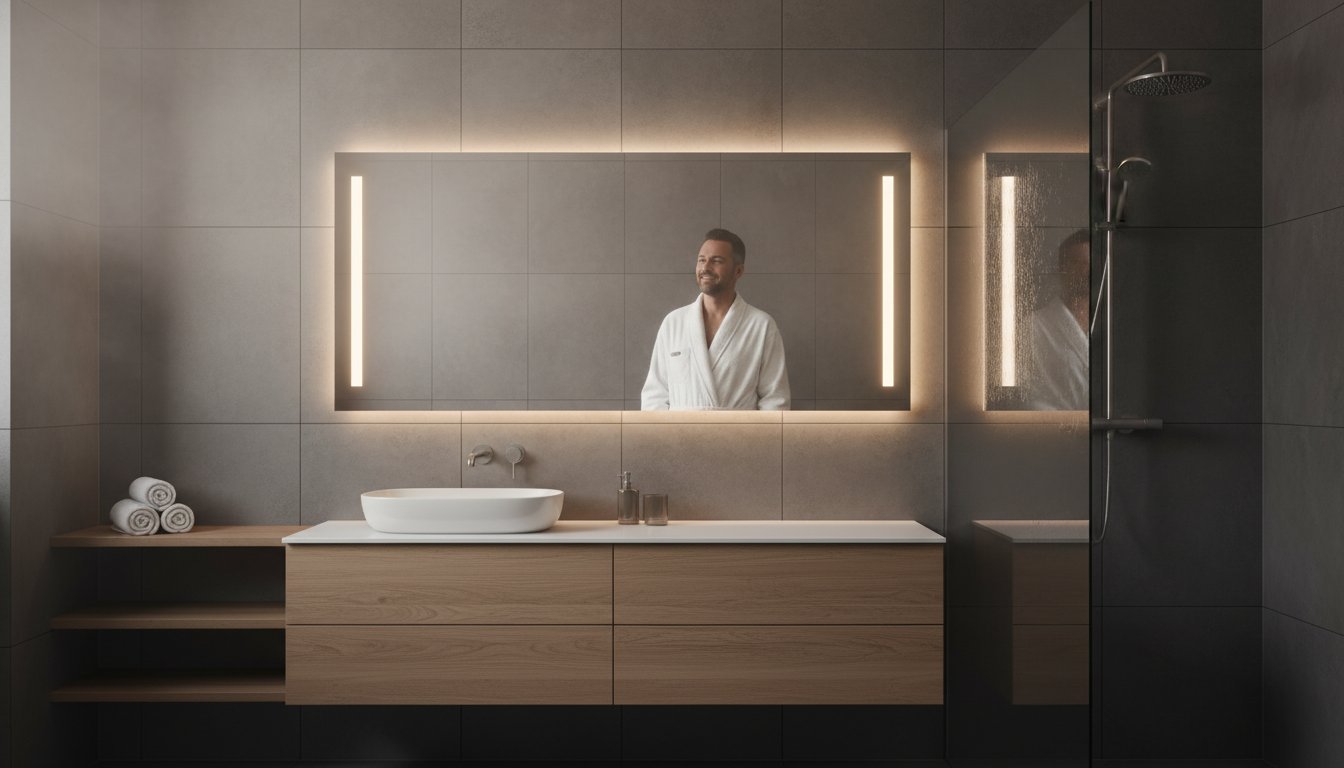
A heated mirror may reduce condensation on its heated glass. Distinguish a demisting film from a mirror panel designed for room heating. Heated mirrors do not all provide sufficient output or approval for the same application.
Key considerations
Check the heated area, output, controls, mounting and permitted bathroom location. Assess demisting and space heating separately. Ventilation and tackling moisture sources remain necessary; mirror heating guarantees no mould-free bathroom.
Condensation and mirror heating
Condensation forms when a surface is colder than the dew point of the surrounding air. Heating the glass may limit this locally. Results depend on humidity, glass and air temperatures, heated area and operating time. Edges or unheated sections may still mist. No universal clearing time applies to the whole mirror. An infrared mirror emits convection heat as well as radiation.
Which specifications matter?
Use exact-model information rather than fixed wattages per mirror area. Room heating requires a heat-loss assessment. Consumption depends on electrical output and actual operating time; annual costs also require a tariff and usage profile. Check glass type and declared electrical protection. CE marking is not an independent quality award; any certification applies only to its specified model and scope.
Choosing a suitable design
Compare dimensions, reflection, heated zone, fixing and supplied components. Demisting film is not automatically less durable than a complete panel; compare actual products and warranties. Lighting, dimming, colour temperature, touch controls and separate switching depend on the model. Check whether light and heat operate independently and which thermostat or sensor is supported. A smart-home logo proves no universal compatibility.
Installation and maintenance
Have bathroom zones, IP protection, electrical class, connections and protective devices assessed together. An IP code alone proves no safe installation near a shower. Earthing follows the electrical class and manual; no single earthing rule applies to every appliance. Check the supporting wall, fixings, cable route and specified clearances. Have fixed wiring completed by a competent person. Clean only when cool and switched off using permitted products; keep water away from electrical parts and inspect cables, glass and controls.
Part of a heating plan
A demister does not automatically replace bathroom heating. A heating mirror can serve as main heating only when the model, output and position suit the heat demand. Additional wall or ceiling panels must be assessed separately; do not simply install a panel above a shower. We support private and business end users, installers and wholesalers with product information and quotations based on photos or floor plans.
Balancing comfort and costs
Choose schedules suited to actual use and approved controls. A motion sensor may not always detect someone showering and must not interrupt necessary operation. Heating does not remove moisture or automatically prevent limescale, bacteria or health problems. Lifespan, origin, payback and carbon effects require product-specific and contextual evidence. Check current support conditions with the responsible authority before including subsidies.
Frequently asked questions
How quickly does the glass clear? This varies by model and conditions; follow the manual when planning start-up. Can any sensor be connected? Only if the combination is electrically and functionally approved. Is DIY mounting possible? Assess mechanical fixing separately from electrical work and have the bathroom installation professionally checked. A thermostat or protective device does not make every location safe. Ask for advice about coverage, output or connections.